Akagera National Park is one of Rwanda’s major wildlife destinations, home to a wide variety of animals, including two species of rhinoceros: black rhinos and white rhinos.
The rhinos are among the attractions drawing tourists to the park. However, visitors can easily confuse the two species because their names do not reflect their actual skin colour.
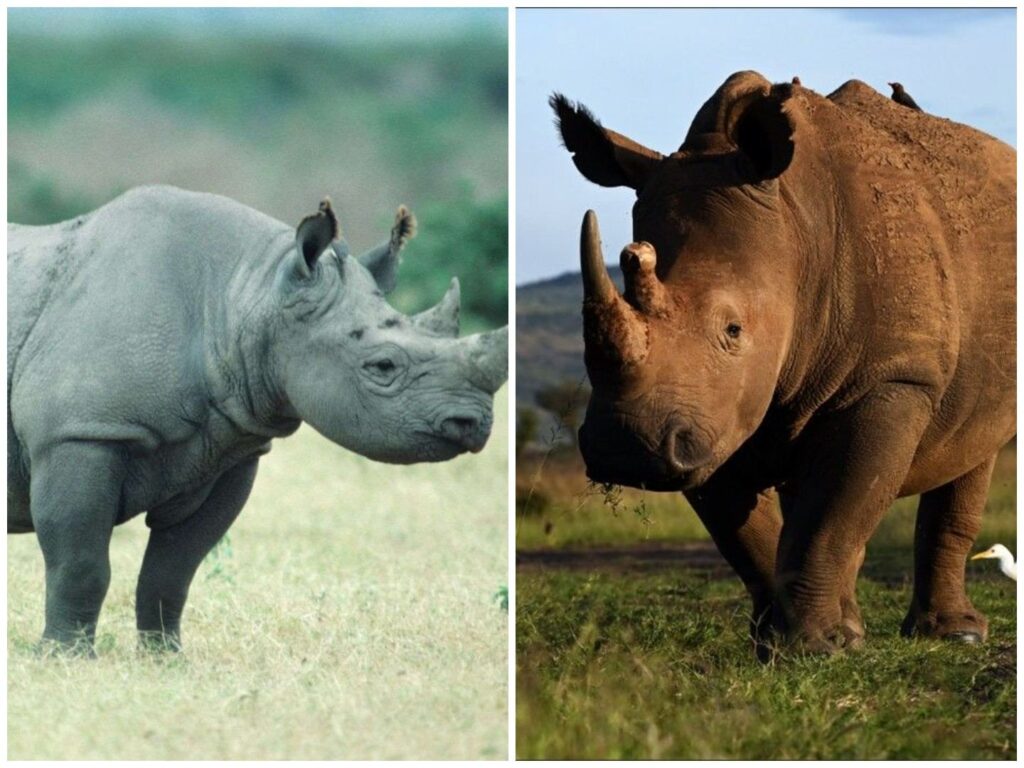
In reality, both species have grey or dark-grey skin, which can appear different depending on the soil or mud they have been rolling in. To tell them apart, visitors need to look beyond their colour and pay attention to several other features.
Mouth shape and feeding habits
White rhinos have broad, flat mouths that help them graze on grass close to the ground. They mainly feed on grass in open grasslands.
Black rhinos, on the other hand, have a long, pointed and hooked upper lip, which they use to grasp branches, pull leaves and feed on foliage from shrubs and trees.
Size and weight
The white rhino is the larger of the two species and one of the biggest land mammals in the world. It can weigh more than 2,000 kilogrammes (two tonnes).
Black rhinos are smaller in comparison, weighing between 800 and 1,400 kilogrammes.
Head shape and forehead
White rhinos have large, elongated heads, which they often hold close to the ground while grazing.
Black rhinos have smaller heads, with a more forward-pointing mouth suited to picking leaves from branches.
Habitat and behaviour
White rhinos are generally calm and more sociable. They are often seen in small groups in open areas, where they graze peacefully.
Black rhinos tend to be solitary and prefer areas with dense bushes. They are territorial, easily startled and can react unpredictably.
Horns
Both species have two horns on their noses, although their relative size and shape can vary.
In white rhinos, the front horn is usually longer and larger than the rear one. Black rhinos also have two horns, with one typically longer than the other.
Social behaviour
White rhinos generally tolerate living alongside one another and can often be seen grazing in groups.
Adult black rhinos, particularly males, tend to live alone. However, they may come into contact with others at different times, including during the breeding season.
Calves
When moving, a white rhino calf usually walks in front of its mother, while a black rhino calf typically follows behind her.
White rhinos can gather in groups, known in English as a crash, while adult black rhinos are more commonly found alone.
When visiting Akagera National Park, tourists can therefore distinguish between black and white rhinos by observing their mouth shape, size, head structure and behaviour, rather than relying on colour.
How did rhinos return to Akagera National Park?
The return of rhinos to Akagera National Park is one of the major milestones in Rwanda’s efforts to conserve biodiversity.
In the 1970s, Akagera was home to more than 50 black rhinos. However, poaching caused their numbers to decline sharply, until the last confirmed sighting of a rhino in the park was recorded in 2007.
After a decade without rhinos in Rwanda, 18 Eastern black rhinos were relocated from South Africa to Akagera in May 2017.
In June 2019, five more black rhinos arrived from wildlife breeding facilities in Europe. Their relocation was intended to increase genetic diversity within the population, support successful breeding and help grow the number of rhinos in the park.
In November 2021, Akagera received 30 white rhinos from Phinda Private Game Reserve in South Africa. The group comprised 19 females and 11 males. They travelled more than 3,400 kilometres aboard a Boeing 747 aircraft before being transported by road to the park.
In June 2025, a further 70 white rhinos were relocated from South Africa under an initiative known as the Rhino Rewild Initiative. The project aimed to increase the population and expand the areas where the animals could safely breed.
This means that between 2017 and 2025, Akagera received 23 black rhinos and 100 white rhinos, excluding those born in the park.