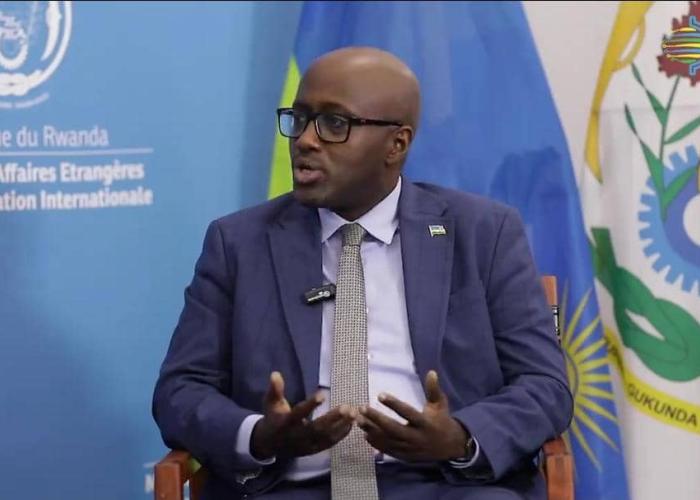
Rwanda’s Minister of Foreign Affairs and International Cooperation, Amb. Olivier Nduhungirehe, has accused Democratic Republic of Congo (DRC) President Félix Tshisekedi of hypocrisy, pointing to what he described as contradictory remarks about international relations and Rwanda’s alleged role in the security crisis in eastern Congo.
Nduhungirehe said Tshisekedi’s statements at the Russia-Africa Summit contradicted his previous calls for Western countries to impose sanctions on Rwanda over its alleged involvement in the conflict in eastern Congo.
The minister made the remarks in response to Tshisekedi’s address at the third Russia-Africa Summit held in Moscow on October 29, 2026.
In a post on social media, Nduhungirehe recalled that Tshisekedi had repeatedly urged Western countries to sanction Rwanda, drawing comparisons between Rwanda’s alleged actions in Congo and Russia’s war in Ukraine. However, he noted that the Congolese leader adopted a different position when addressing the summit in Moscow.
During the meeting, Tshisekedi defended Congo’s right to make independent decisions, arguing that expanding cooperation with other countries should not be interpreted as choosing sides in international affairs.
Tshisekedi’s remarks on insecurity in eastern Congo
In his address, Tshisekedi described insecurity in eastern Congo as one of the major challenges facing his country, accusing armed groups of exploiting its natural resources to finance conflict and undermine development.
He said Congo was seeking lasting peace that would enable its citizens to live in security while restoring the government’s authority across the country’s territory.
Tshisekedi added that his government continued to pursue a diplomatic solution, particularly through the Washington and Doha processes, with the support of the African Union (AU)-led mediation efforts.
However, he cautioned that the progress achieved through these initiatives would be meaningless unless the agreements were implemented in a tangible and verifiable manner.
He also referred to United Nations Security Council resolutions, including Resolutions 2773 and 2808, which call for an end to hostilities, the withdrawal of the M23 rebel group from areas under its control and the withdrawal of Rwandan troops from Congolese territory.
Tshisekedi further called for an end to all forms of support for armed groups and urged the implementation of measures to weaken the FDLR militia.
He appealed to Russia, as a permanent member of the UN Security Council, to support the implementation of these resolutions and ongoing efforts to restore peace.
The Congolese leader also stressed that protecting civilians, facilitating humanitarian operations and ensuring the voluntary, safe and dignified return of refugees should remain priorities.
In his response, Nduhungirehe recalled that Tshisekedi had for years travelled to Belgium and other European capitals to lobby for sanctions against Rwanda over what he described as its involvement in insecurity in eastern Congo.
He said Tshisekedi had repeatedly compared what he termed Rwanda’s aggression against Congo to Russia’s war in Ukraine, urging Western countries to impose sanctions on Rwanda similar to those imposed on Russia.
“This is blatant hypocrisy. President Félix Tshisekedi has forgotten that, over the past several years, he has repeatedly appeared in Brussels, the capital of Belgium, and other European capitals, criticising what he considers the European Union’s application of double standards and calling on Western countries to sanction Rwanda, which he accuses of being an aggressor state, just as they sanctioned Russia, which is also accused of being an aggressor state,” Nduhungirehe said.
He cited Tshisekedi’s visit to Brussels on February 28, 2024, when the Congolese leader called for sanctions against Rwanda, arguing that they were the only way to make President Paul Kagame change his behaviour.
Nduhungirehe argued that Tshisekedi’s repeated calls for European countries to sanction Rwanda, based on comparisons with the measures imposed on Russia over the war in Ukraine, were inconsistent with his position in Moscow, where he defended countries’ freedom to make independent decisions and avoid taking sides.
In his Moscow address, Tshisekedi said Congo did not want to choose sides in international relations, arguing that expanding partnerships with other countries was a way of strengthening its independence in decision-making.
He also called for a world order based on multilateral cooperation, in which every country, regardless of its size or influence, has its sovereignty respected.
His remarks on the war in Ukraine further highlighted this position. Tshisekedi stressed the need to continue pursuing dialogue and diplomatic solutions, even when opposing sides hold different views, while maintaining the protection of civilians as a priority.
Nduhungirehe cited these statements as evidence of what he described as Tshisekedi’s contradictions, arguing that while the Congolese president urges sanctions against Rwanda by comparing it to Russia, he was simultaneously defending countries’ right to choose their partners and make independent decisions at a summit hosted by Russia.
Congo has repeatedly accused Rwanda of supporting the M23 rebel group and violating its territorial integrity. Rwanda denies the allegations, maintaining that insecurity in eastern Congo stems from internal challenges, including the Congolese government’s failure to fulfil its commitments to eliminate the FDLR militia, which Kigali considers a serious security threat.
On October 28, 2026, the United States imposed sanctions on Rwanda’s Ministry of Defence and Zigama Credit and Savings Society, accusing them of supporting M23. Rwanda has continued to reject allegations that it backs the armed group.
Nduhungirehe recently reiterated that Rwanda should not be held responsible for all security challenges in Congo, arguing that the crisis is largely rooted in the country’s internal problems and requires a political solution.