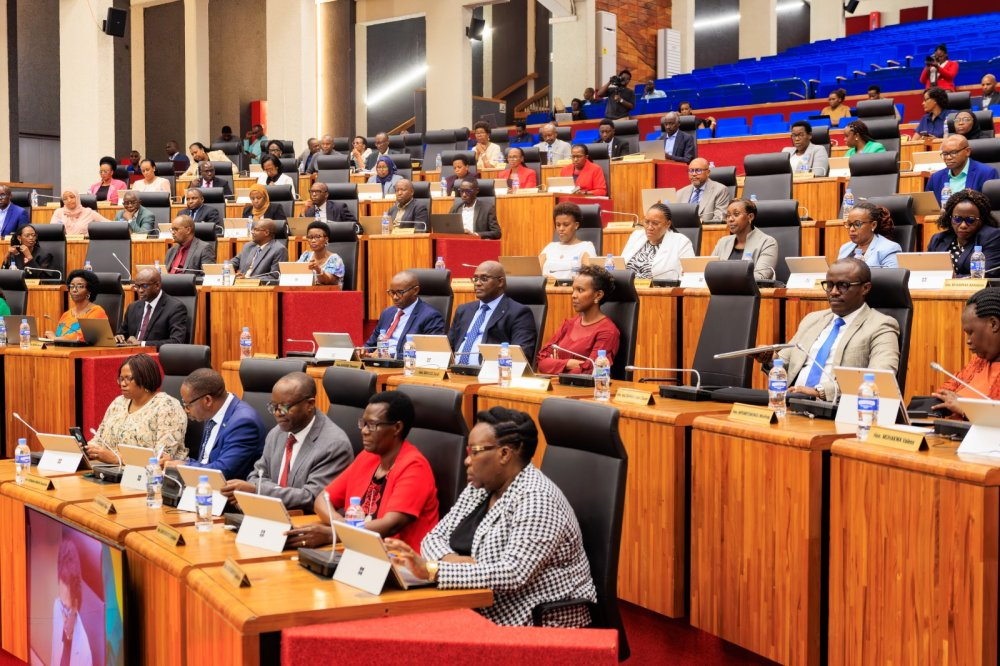
The Parliament of Rwanda has approved a national budget of Rwf 7,796.3 billion for the 2026/2027 fiscal year, marking an increase of Rwf 844.2 billion compared to the revised 2025/2026 budget of Rwf 6,952.1 billion.
The approval was made on Thursday, June 11, 2026, following the presentation of the draft budget by the Minister of Finance and Economic Planning, Yusuf Murangwa.
Revenue outlook
Murangwa told lawmakers that domestic revenues for the 2026/27 fiscal year are projected at Rwf 5,273.8 billion, while external grants are expected to contribute Rwf 548.3 billion. Foreign borrowing is projected at Rwf 1,974.1 billion.
Overall, domestic resources and external borrowing will account for about 93% of the total budget.
Spending priorities
The Minister said Rwf 4,788.5 billion, or 61%, will go to recurrent expenditure, including wages and operational costs, while Rwf 3,010.8 billion, or 39%, will be allocated to development spending and public investment projects.
He said the budget priorities are aligned with the National Strategy for Transformation (NST2), Vision 2050, and efforts to cushion the economy against external shocks, including ongoing geopolitical tensions affecting global markets.
Allocation across key sectors
Under the economic transformation pillar, which focuses on inclusive growth and job creation, Rwf 4,900 billion has been allocated, representing 62% of the budget.
The social transformation pillar has been allocated Rwf 1,711.3 billion, or 21.9%, aimed at improving living standards and access to services.
The governance and justice pillar has been allocated Rwf 1,184 billion, or 15.2%, with emphasis on strengthening institutions and promoting accountability.
MPs call for stronger focus on agricultural skills
During deliberations, Members of Parliament called for greater investment in agricultural skills development to improve productivity in the sector.
Deputy Munyangeyo Theogene noted that while funding for agriculture is increasing, more attention is needed on training farmers and strengthening agricultural education and research.
He cited productivity gaps in dairy farming, pointing to Nyagatare District where average milk yield is estimated at 1.6 litres per cow, compared to research-based potential of 30 to 40 litres under improved management systems.
“There is a need to expand technical and vocational education in agriculture and enhance awareness to improve productivity,” he said.
The budget was unanimously approved by all 65 Members of Parliament.