Rwanda’s Agriculture and Animal Resources Development Board (RAB) says it will work with relevant authorities to investigate milk traders accused of sharply raising prices despite processors maintaining their wholesale rates.
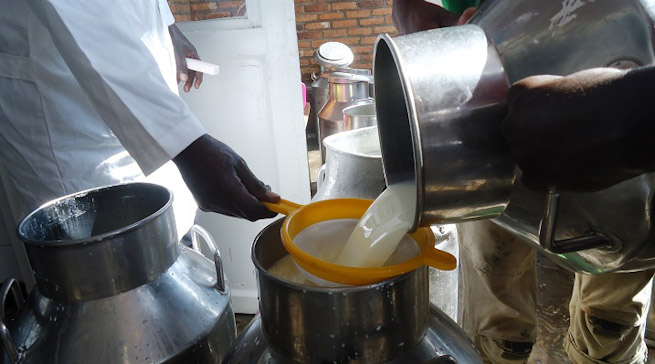
The move follows complaints from consumers in Kigali over rising milk prices and shortages, with some retailers selling raw milk for between Rwf800 and Rwf1,000 a litre, up from about Rwf600 before the dry season.
RAB acknowledges that the prolonged dry spell has reduced milk production, particularly in the Eastern Province, which supplies an estimated 40% to 50% of the milk consumed in Rwanda.
Dr Eugène Niyonzima, head of the livestock value addition department at RAB, said the shortage of water and pasture has significantly affected milk yields.
“Milk is about 87% water, so it is understandable that when water availability declines, particularly during the dry season, milk production also falls,” Niyonzima told Rwanda Broadcasting Agency.
He cited Nyagatare District, where daily milk production has fallen from about 100,000 litres during the rainy season to between 20,000 and 30,000 litres during the current dry spell.
Despite the production decline, RAB says the increase in retail prices cannot be attributed to milk-processing companies.
Niyonzima said information available to RAB shows that processors have maintained their prices, while some traders have increased retail prices even though they continue to buy milk at unchanged rates.
“Information we have from milk-processing companies shows that their starting prices have not changed. Instead, some traders have increased prices even though they are buying the milk at the same price,” he said.
RAB said it will work with the Ministry of Trade and Industry and other relevant institutions to examine how milk prices are determined and establish the reasons behind the increases.
The investigation comes after the Ministry of Trade and Industry said the government would no longer impose a fixed retail price for milk. Instead, prices would be determined through agreements between dairy farmers and buyers.
Farmers have previously complained about a wide gap between the prices they receive for milk and the prices paid by consumers, arguing that much of the value is captured by intermediaries along the supply chain.
Prices of processed milk have also risen in recent weeks.
Inyange Industries recently said a carton containing 12 packs of 500ml milk should be sold to wholesalers for Rwf8,000 and for Rwf8,500 in designated Milk Zones.
The clarification followed reports of steep price increases and shortages of Inyange milk in Kigali. In some outlets, a carton of 12 500ml packs was reportedly selling for as much as Rwf20,000, while individual packs were being sold for up to Rwf1,500.
The combination of reduced production and tight supplies has left consumers facing both higher prices and difficulty finding milk, prompting authorities to scrutinize the role of traders in the latest price increases.