Ten years on, a once-promising project expected to pioneer plant-based diesel (biodiesel) production in Rwanda has collapsed, leaving hundreds of residents unpaid and stripped of more than Rwf 38 million in wages.
In November 2009, the Government of Rwanda signed an investment agreement with the British company ECO Positive Ltd, led by Karl Boyce.
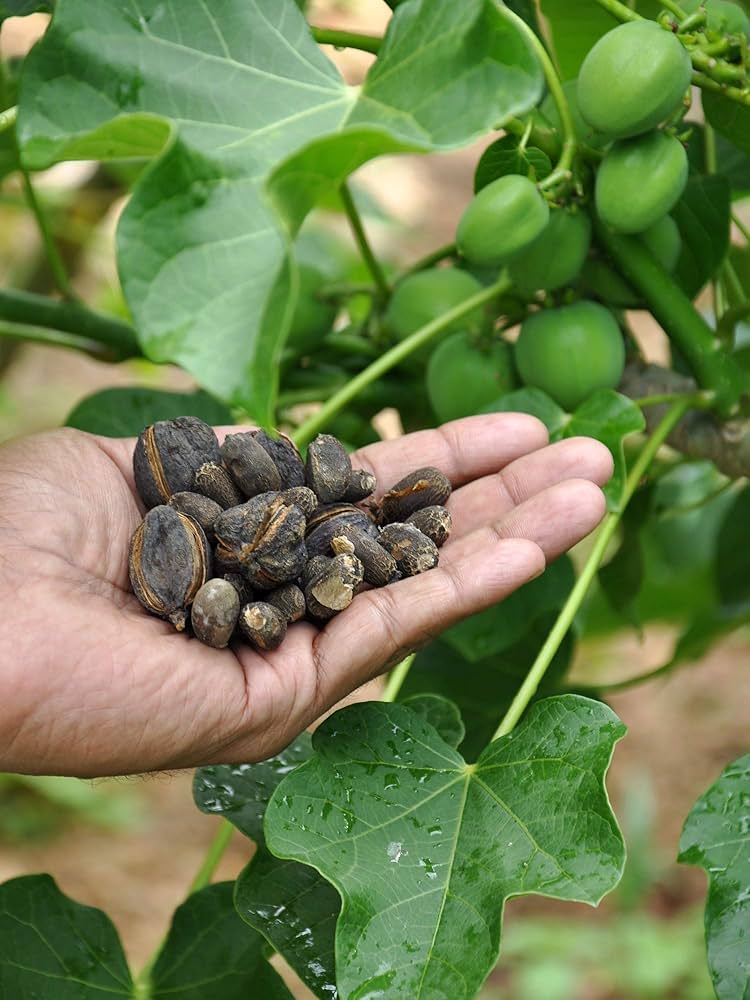
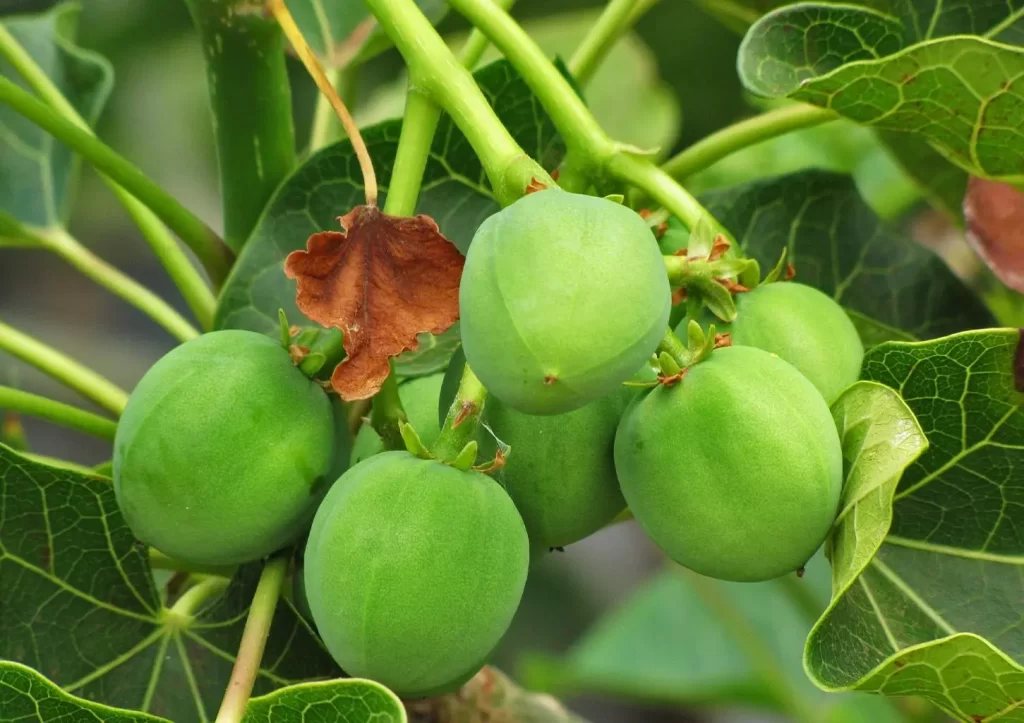
The deal envisioned a USD 250 million investment to cultivate Jatropha, a plant used to produce biodiesel, across 10,000 hectares near the boundaries of Akagera National Park, specifically in Rwinkwavu Sector, Kayonza District, Eastern Province.
However, by September 2015, several government institutions—including the Rwanda Development Board (RDB), the then Ministry of Natural Resources (MINIRENA), and the Ministry of Infrastructure (MININFRA)—met to review the project’s poor performance.
They found that between 2012 and 2014, only less than 3% of the planned 7,500 hectares had been planted. Authorities subsequently decided to halt the project, citing the crop’s unsuitability for Rwanda.
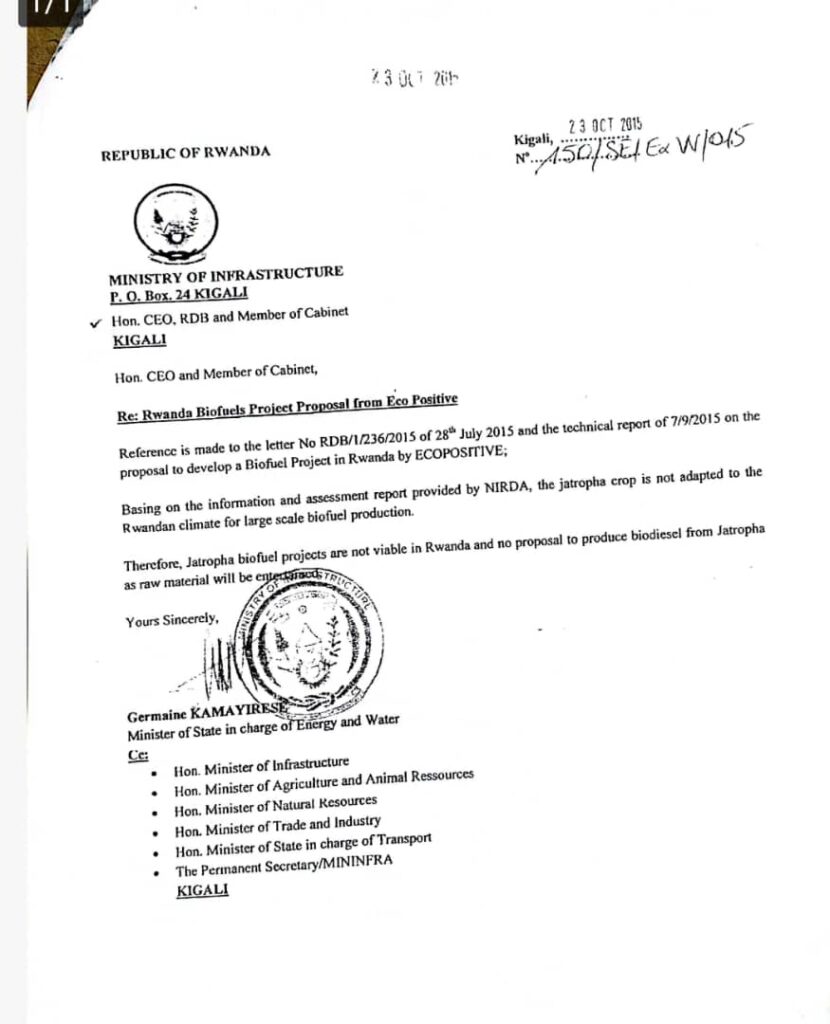
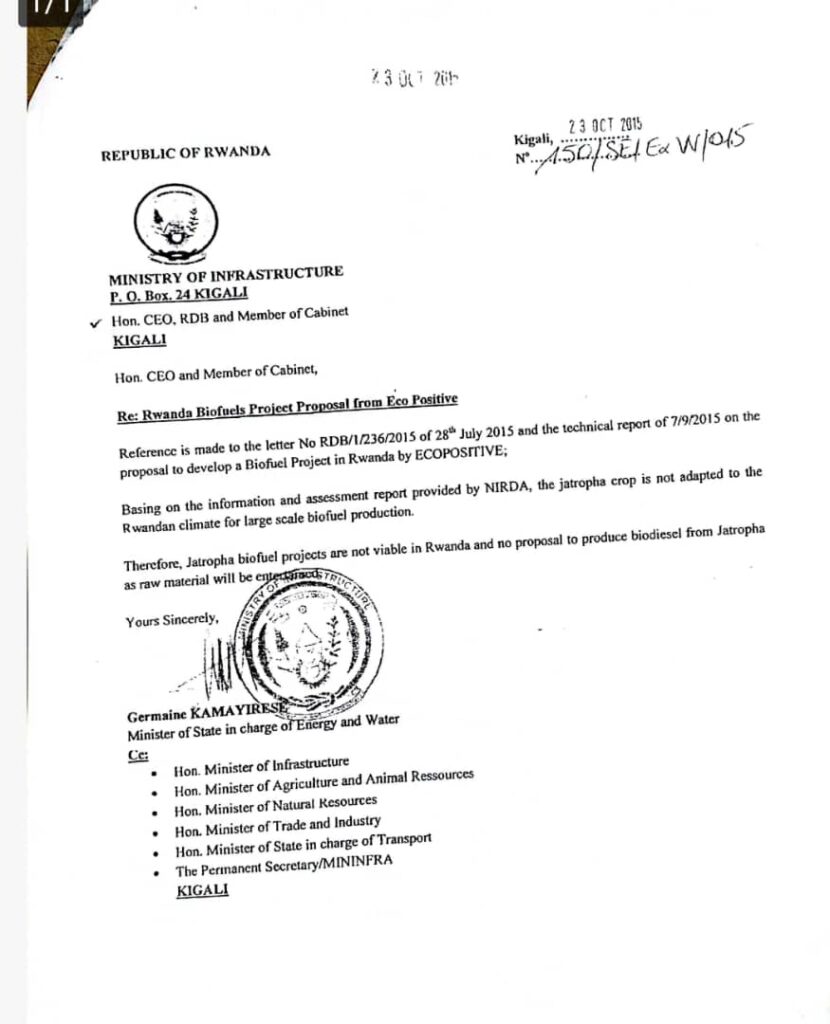
In October 2015, MININFRA formally notified the company that Jatropha cultivation had been suspended in Rwanda. The ministry explained that the crop was incompatible with Rwanda’s soils and that it was difficult to access the basic equipment needed to process biodiesel.
After the halt, investor Karl Boyce shifted operations to Bugesera District, Nyamata Sector, where he established ARC Power Limited, a solar mini-grid power company.
Unpaid workers, Rwf 38 million in arrears
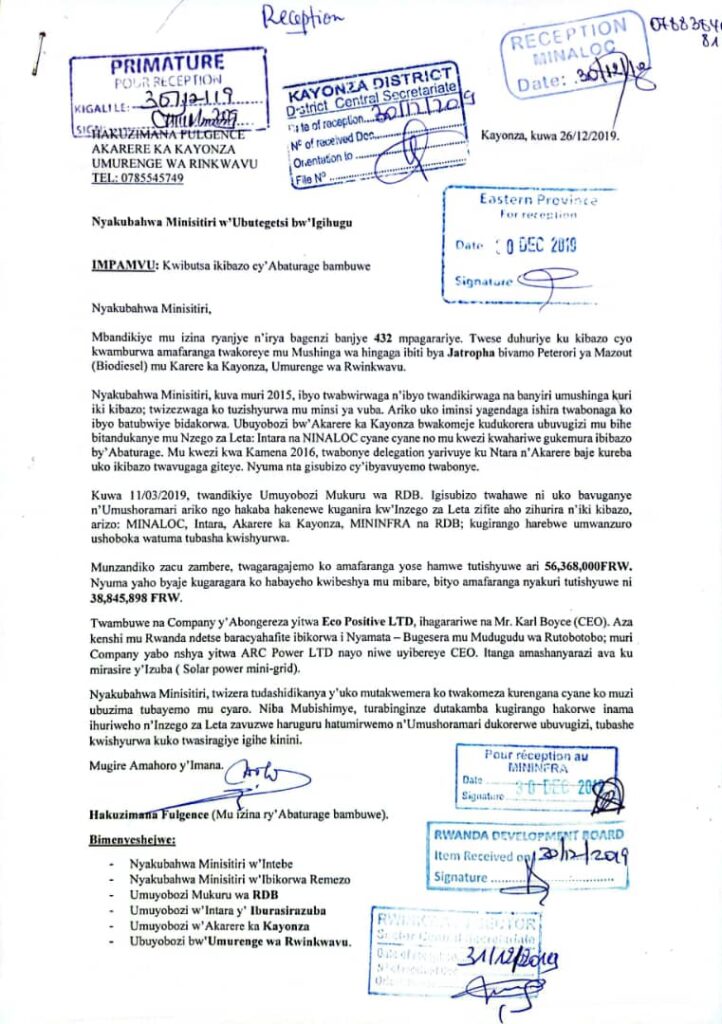
Following the project’s suspension, 432 residents who had been employed say they were never paid wages totaling Rwf 38,845,898.
They report having raised the issue with district authorities, the Ministry of Local Government, and RDB, but claim they were repeatedly delayed and assured the matter would be resolved—assurances that have not materialized even after a decade.
A workers’ representative told UMUNOTA that the issue is widely known within government institutions.
“The investor left without paying us. We reported the matter to many state institutions, but it has not been resolved. The government had said it would pay the workers and then pursue the investor,” he said.
He added that while officials repeatedly promised follow-up, inquiries now often go unanswered.
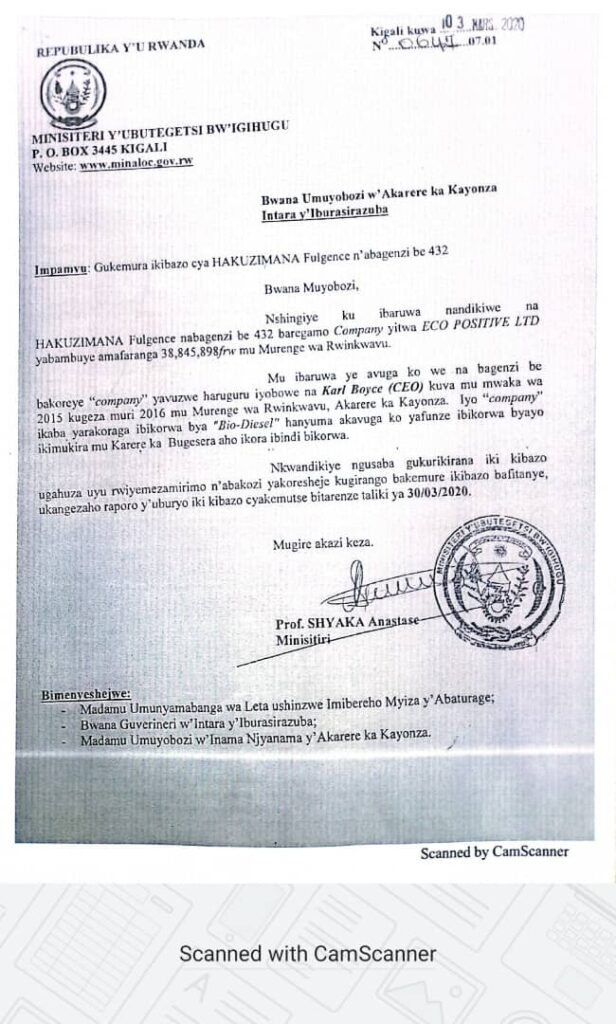
A letter dated 2020, seen by UMUNOTA and signed by then Minister of Local Government Prof. Anastase Shyaka, instructed the Kayonza District leadership to follow up the case and submit a report by March 30, 2020 on how it had been resolved.
Where does the case stand?
Fred Hategekimana, the acting Mayor of Kayonza District, confirmed that authorities are aware of the case and that efforts are underway to resolve it.
“Recently, the district formed a team to reassess the situation—verify the number of affected residents, review the validity of documents, and determine what support can be provided,” he said.
He added that the district is working with national institutions, including RDB, to find a solution and ensure residents are paid.
“Although the investor left without paying about Rwf 38 million, we are coordinating with relevant institutions to find a concrete solution. In the near future, we expect to communicate a clear outcome to the affected residents.”
Why the project failed
Sources indicate the project was abandoned because biodiesel proved more expensive than imported fossil diesel, while Jatropha yields in Rwanda were very low.
Minutes from the Cabinet meeting of April 18, 2012, held at Village Urugwiro and chaired by President Paul Kagame, show that ministers reviewed a report on the Jatropha biodiesel project and called on relevant institutions to address obstacles hindering its progress.
Under the agreement, the government initially allocated 8,600 hectares in Kayonza District, with a pledge to add 1,600 more hectares, aiming to produce 16 million liters of bio-energy within six to seven years.
The contract granted the company 49 years to use the land—part of Rwanda’s ambition to become one of Africa’s early adopters of plant-based energy in line with global efforts to reduce greenhouse gas emissions.
A decade later, that ambition remains unrealized, while hundreds of workers continue to wait for wages they say are long overdue.