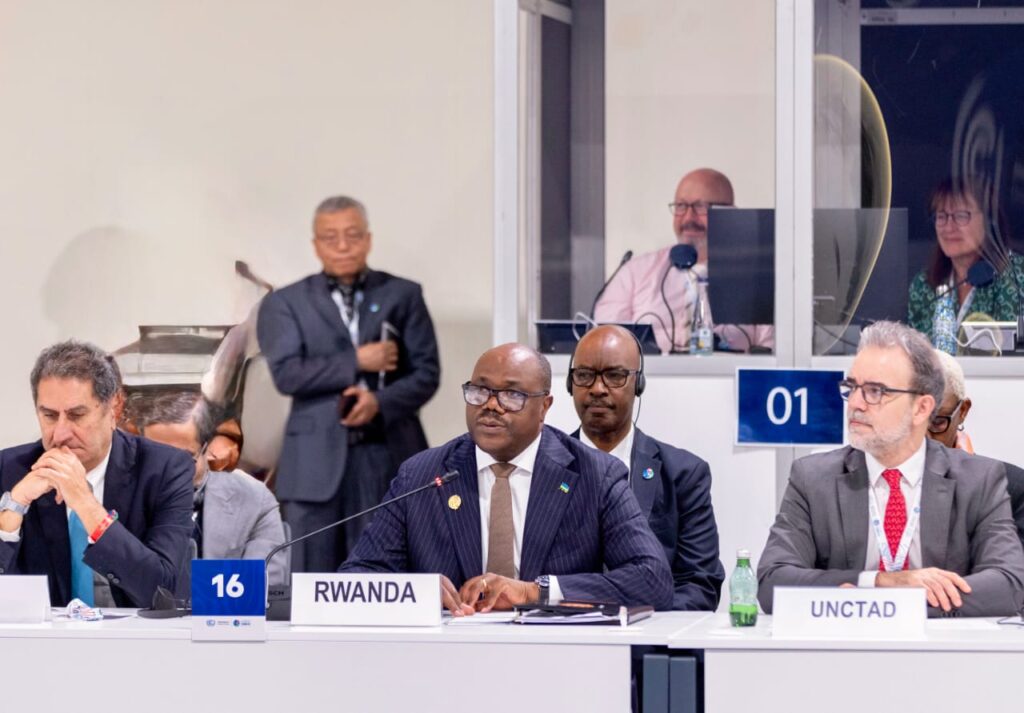
Prime Minister Dr Justin Nsengiyumva has outlined Rwanda’s priorities for expanding electricity infrastructure, increasing investment in climate action and developing cities that can withstand the effects of climate change.
He highlighted the measures during three high-level discussions at the United Nations Climate Change Conference (COP31), where Rwanda emphasised the importance of translating commitments into practical action and securing adequate financing to achieve sustainable development.
During a session on accelerating electricity infrastructure development, the Prime Minister said electricity should go beyond providing households with power and serve as a foundation for economic growth through industrialisation, business development, job creation and regional market integration.
He explained that under Rwanda’s Mission 300 National Energy Compact, the country has set targets to expand electricity access and strengthen its power transmission networks.
The targets include increasing electricity transmission capacity by 70%, doubling cross-border electricity trade with neighbouring countries from 100 megawatts to 200 megawatts, and achieving universal electricity access by 2030.
He said achieving these ambitions would require $3.05 billion, of which $1.3 billion would be invested in electricity transmission infrastructure.
Although existing programmes rely partly on development assistance and government funding, he stressed that countries should not depend solely on their national budgets. Instead, he called for stronger partnerships with private investors, international financial institutions and development partners.
Rwanda expressed its readiness to work with these partners to develop and mobilise financing for four to six priority projects aimed at expanding electricity access and strengthening regional power interconnections.
During another session focusing on the implementation of the Paris Agreement on climate change, which marked 10 years since its implementation began, Dr Nsengiyumva said Rwanda considers climate action an integral part of its national development agenda.
He said the country aims to build a developed economy that is resilient to climate change and environmentally sustainable within the next 20 years.
The ambition is anchored in Vision 2050 and Rwanda’s Green Growth and Climate Resilience Strategy.
He also highlighted the institutions and mechanisms established to support the implementation of this agenda, including the Rwanda Green Fund (FONERWA), climate-responsive budgeting and the Green Taxonomy, which provides guidelines for investment in environmentally sustainable projects.
The Prime Minister noted that inadequate and delayed climate financing remains a major obstacle. He therefore called on development partners to strengthen cooperation, facilitate technology transfer to developing countries and accelerate the implementation of climate projects.
In a third discussion focusing on strengthening urban resilience to climate change, Dr Nsengiyumva said cities require urgent attention because they concentrate large populations and critical infrastructure.
He said Rwanda has prioritised nature-based solutions, particularly to reduce flood risks and promote sustainable urban settlements.
Citing Kigali as an example, he noted that the city’s population has nearly tripled within a generation, prompting the government and its partners to invest approximately $195 million in flood-risk reduction, upgrading informal settlements, road construction and the restoration of five urban wetlands covering nearly 500 hectares.
He explained that these interventions have helped reduce flood risks for more than 220,000 people while also creating public recreational spaces, employment opportunities and avenues for economic development.
Rwanda intends to extend similar approaches to secondary cities and other urban centres beyond Kigali as part of its Nationally Determined Contribution (NDC 3.0).
The Prime Minister also expressed the country’s willingness to share Kigali’s experience with other nations, calling on development partners to mobilise funding and investment for projects that support safe and climate-resilient cities.
Across the three discussions, Rwanda emphasised the need to move beyond commitments and plans towards tangible action through adequate financing, technology and long-term partnerships to ensure that climate action delivers benefits to communities.