Rwanda has welcomed remarks by U.S. Secretary of State Marco Rubio recognizing the country’s fulfillment of its commitments in ongoing efforts to resolve the conflict in eastern Democratic Republic of the Congo (DRC).
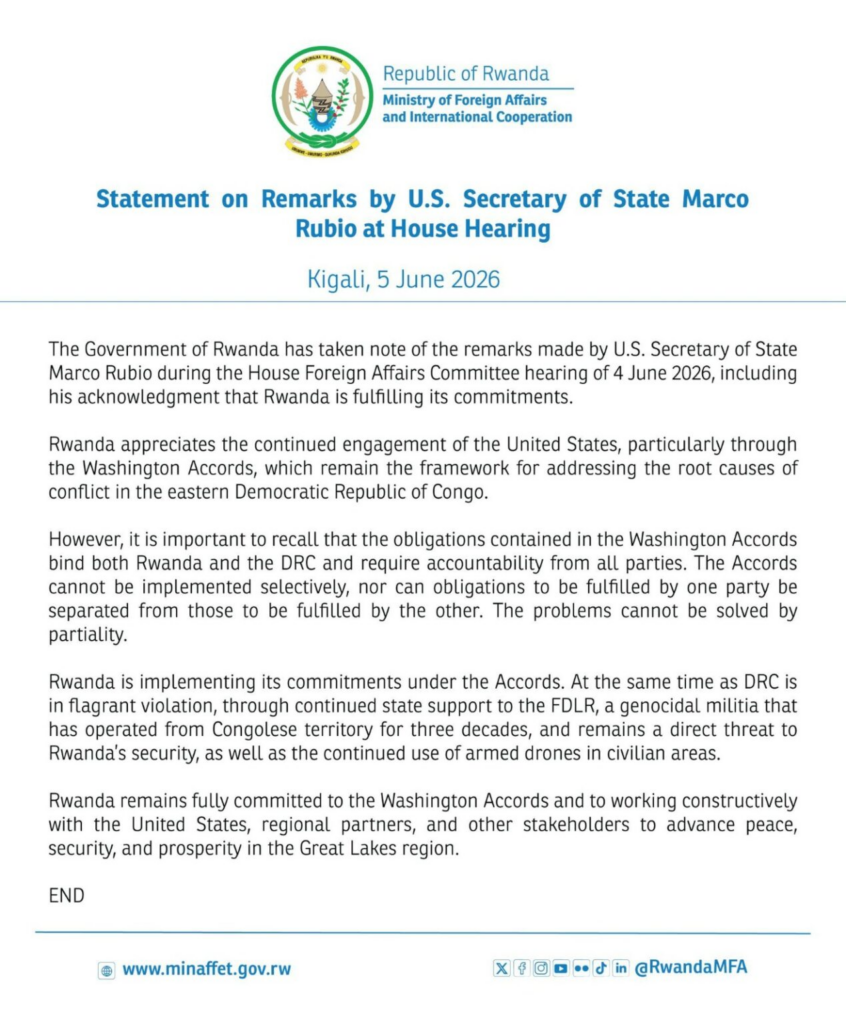
In a statement issued on Friday, June 5, Rwanda’s Ministry of Foreign Affairs said it appreciated Rubio’s acknowledgment, describing it as a reflection of the strong partnership between Kigali and Washington in advancing peace and stability in the Great Lakes region.
Rubio made the remarks during a hearing before the U.S. Congress Foreign Affairs Committee on June 4, where he noted that Rwanda had met its obligations under the diplomatic process aimed at easing tensions between Rwanda and the DRC.
“The Government of Rwanda has taken note of the remarks made by U.S. Secretary of State Marco Rubio, including his confirmation that Rwanda has fulfilled its commitments,” the ministry said.
Kigali also praised U.S. engagement in the peace process, particularly through the Washington Agreement framework, which it said remains critical to addressing the root causes of insecurity in eastern DRC.
“Rwanda appreciates the support of the United States, especially through the Washington Agreement, which continues to provide an important framework for tackling the underlying drivers of conflict in eastern Democratic Republic of the Congo,” the statement added.
At the same time, Rwanda stressed that progress depends on all parties honoring their obligations, warning that durable solutions cannot be achieved through selective implementation or one-sided approaches.
The government further accused the DRC of failing to fully comply with agreed commitments, citing what it described as ongoing cooperation between Congolese authorities and the FDLR, an armed group linked to perpetrators of the 1994 Genocide against the Tutsi that has operated from Congolese territory for decades.
Rwanda reiterated its commitment to working with international partners to advance lasting peace, security, and stability across the Great Lakes region.