Implementation of the peace agreement between Rwanda and the Democratic Republic of Congo (DRC) has reached 35% one year after its signing, according to a new report by the Barometer of Peace Agreements in Africa (BAPA).
The agreement was signed in Washington on June 27, 2025, by Rwanda’s Minister of Foreign Affairs, Amb. Olivier Nduhungirehe, and his Congolese counterpart Thérèse Wagner Kayikwamba, with the aim of ending long-standing tensions in eastern DRC.
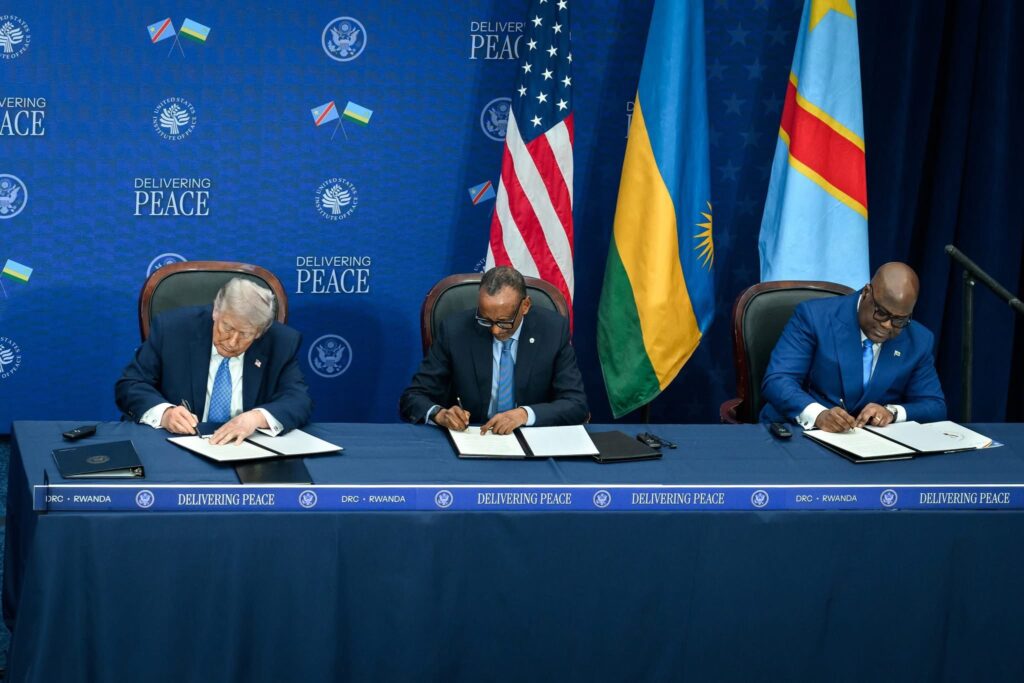
A follow-up framework, the Washington Accords, was signed on December 4, 2025, bringing together President Paul Kagame, President Félix Tshisekedi, and former U.S. President Donald Trump, to strengthen efforts toward ending decades of conflict in the region.
The BAPA report notes some progress in establishing cooperation mechanisms and initiating agreed activities. However, it emphasizes that most commitments remain at an early stage of implementation.
Out of 30 agreed actions, only three have been fully implemented, 19 are ongoing, while eight have yet to begin.
While implementation has improved compared to the initial months after signing, BAPA says overall progress remains below expectations.
The report further shows that the DRC has implemented 31.7% of its commitments, while Rwanda stands at 30.6%. International mediators, including the United States, Qatar, and the African Union, have achieved 53.5% implementation of their assigned roles.
BAPA highlights sustained political engagement from all parties, but warns that key security issues remain unresolved, including the disarmament of armed groups, trust-building measures, and the establishment of a credible monitoring mechanism.
It also points to continued clashes in eastern DRC between AFC/M23 and the Congolese army (FARDC), underscoring persistent instability despite the agreements.
The report identifies the lack of a clear verification framework for the dismantling of the FDLR as a critical gap that could undermine progress, citing risks of differing interpretations by the parties involved.
Meanwhile, it notes that recent U.S. sanctions targeting individuals in Rwanda’s Defence Force and entities linked to the gold sector have added pressure to the process, contributing to a slowdown in implementation momentum.
Rwanda has previously described the sanctions as biased, arguing they lack sufficient evidence and due process.
Despite ongoing challenges, both countries have agreed on priority areas of cooperation, including energy, cross-border infrastructure, mining and mineral processing, environmental conservation, tourism, and health sector development.