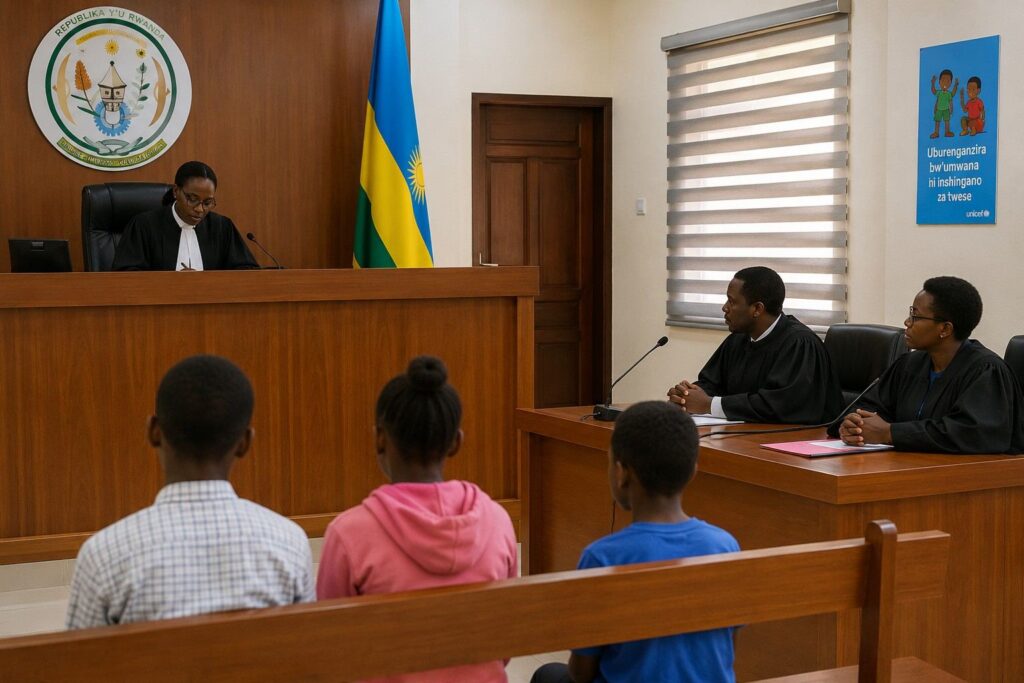
Rwanda’s Supreme Court has introduced new procedures for handling cases involving children, including dedicated hearing days, separate waiting areas and courtroom arrangements designed to make children feel safer and less intimidated.
The new rules, published in the Official Gazette on October 1, 2026, are intended to ensure that children involved in court proceedings receive justice that is faster, more protective and focused on their best interests.
Under the new procedures, courts are expected to prioritise cases involving children and take steps to protect them from fear, embarrassment, emotional distress and exposure that could undermine their dignity and privacy.
Courtrooms to be made less intimidating
Where possible, courts will designate specific days and judges to handle cases involving children. Such cases are also expected to receive priority from the time they are scheduled through the hearing and decision-making stages.
Before a child-related case is placed on the hearing calendar, court registries must hold a pre-trial meeting, including through digital means where appropriate, to ensure that the case file is complete and that the child is ready to participate in the proceedings.
The rules require courtrooms handling cases involving children to be arranged in a way that creates a calm and child-friendly environment.
Uniformed security officers should not be visible during such hearings unless their presence is considered necessary for security reasons.
Judges, prosecutors and lawyers handling cases involving children are also not required to wear their professional robes during the proceedings.
The rules further require legal professionals and other participants to use language that a child can understand and to explain relevant aspects of the proceedings in a way appropriate to the child’s age and understanding.
Children to be separated from adults
The new procedures require children appearing in court to be kept separate from adults before and after hearings and placed in safe areas where they are unlikely to feel intimidated.
A child may also attend court accompanied by a trusted adult and, where necessary, a legal representative.
Children in custody who are suspected of committing offences are to be brought to court through arrangements that keep them separate from other parties to the proceedings.
Cases involving children will generally be heard in private. Attendance will be limited to judges, court staff, parties to the case, legal representatives and necessary witnesses.
Parents or guardians and a child protection or welfare officer may also attend, alongside other people the court considers necessary.
Children appearing as witnesses or providing information or views will be placed in a designated safe area.
In divorce proceedings, a child’s views will not be disclosed to the parties unless the child agrees.
Stronger protection of children’s identities
The new rules impose strict confidentiality requirements for children involved in court cases.
The identity of a child accused of an offence, a child who is a victim, or a child appearing as a witness must not be recorded in court proceedings in a way that identifies them, made public or disclosed to the media.
People authorised to attend hearings are also prohibited from disclosing information concerning cases involving children.
The measures are intended to prevent children from being exposed to public scrutiny or information that could affect their wellbeing long after a case has ended.
Rehabilitation takes priority over punishment
The new procedures also emphasise rehabilitation when courts are dealing with children accused of offences.
When making decisions, courts are expected to prioritise measures aimed at correcting and rehabilitating the child rather than punishment, where the law allows.
Where appropriate, courts may encourage parties to use alternatives such as agreements based on an admission of guilt or reconciliation between the offender and victim, provided such approaches are consistent with the law.
The new framework places the child’s best interests, dignity, privacy and rehabilitation at the centre of proceedings, marking a shift towards a more child-sensitive approach to justice.