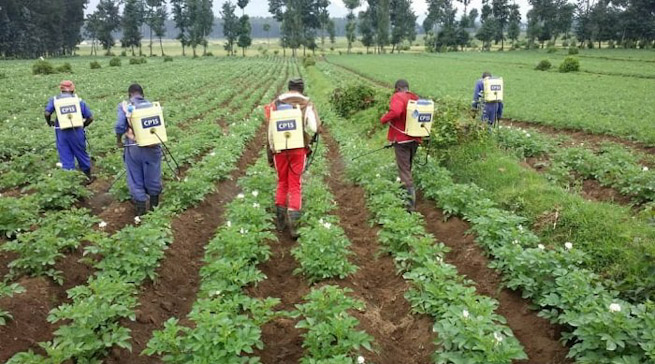
The National Institute of Statistics of Rwanda (NISR) has reported an increase in the production of key food crops during the 2026 A agricultural season, with bananas, potatoes, and sweet potatoes all posting gains compared to the same season in 2025.
In a report released on April 15, 2026, NISR said banana production rose by 4.1% to over 1.3 million tonnes, while potato output increased by 3.3% to 491,564 tonnes. Sweet potatoes also grew by 3%, reaching 675,768 tonnes.
The report shows that more than one million hectares were cultivated with seasonal crops, alongside 501,000 hectares used for perennial crops such as coffee, tea, and bananas, while 84,000 hectares were reserved for permanent pasture.
Bean production increased slightly to 229,396 tonnes, up 0.5%, while rice production rose by 2% to 71,080 tonnes.
Maize was grown on 245,405 hectares, beans on 327,907 hectares, potatoes on 55,310 hectares, sweet potatoes on 96,217 hectares, cassava on 236,357 hectares, and bananas on 267,676 hectares.
The survey indicates that improved seeds were used by 37% of farmers nationwide, with adoption rates significantly higher among large-scale farmers (82.6%) compared to smallholders (35.2%).
Organic fertiliser usage remained widespread at 90.2%, while chemical fertiliser was used by 67.2% of farmers. Pesticides were applied by 46.9%, with usage again higher among large-scale farmers.
Only 14.4% of farmers reported using irrigation during the season, although 92.4% said they applied at least one soil conservation method.
The report also highlights that 53.4% of farmers practiced agroforestry, while mechanisation remained low at just 1.7%.
NISR also recently reported a 9.2% increase in food prices in March 2026 compared to the same period in 2025.
The seasonal agricultural survey is conducted to track sector performance and inform policy decisions aimed at strengthening agricultural productivity and food security in Rwanda.