July 19, 1994, stands as one of the most defining dates in Rwanda’s history. It was on this day that the Government of National Unity was sworn in, marking the beginning of the country’s reconstruction following the 1994 Genocide against the Tutsi.
The government assumed office just one day after the Rwanda Patriotic Army (RPA) declared an end to the war, having defeated the genocidal regime and brought the Genocide against the Tutsi to a halt. It also came three years, nine months and 19 days after the Rwanda Patriotic Front (RPF) launched the liberation struggle on October 1, 1990.
By the time the new administration was formed, the RPA had liberated key parts of the country, including Kigali on July 4, Ruhengeri on July 14 and Gisenyi on July 17. The defeated government and its forces had fled into what was then Zaire, leaving behind a country devastated by genocide.
Rwanda faced enormous challenges. More than one million people had been killed during the Genocide against the Tutsi, millions had been displaced, infrastructure lay in ruins, and bodies of victims remained scattered across the country awaiting dignified burial.
On July 17, then-RPF Chairman Colonel Alexis Kanyarengwe announced that a Government of National Unity would be established in line with the 1991 Constitution and the Arusha Peace Agreement. He said the MRND and CDR, which had played central roles in planning and carrying out the Genocide against the Tutsi, would not be part of the new administration. He also announced the creation of the offices of Vice President and the Transitional National Assembly.
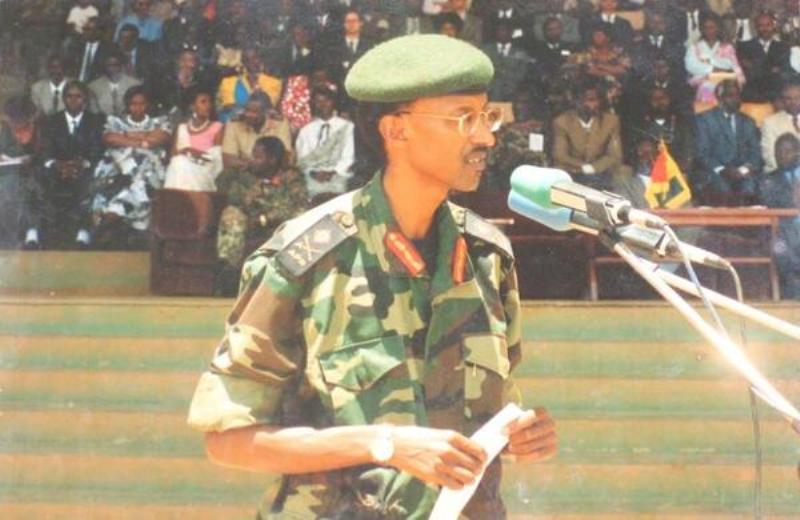
On July 18, Major General Paul Kagame, who commanded the RPA during the liberation struggle, declared the war over. A day later, the Government of National Unity was officially inaugurated.
Pasteur Bizimungu was sworn in as President of the Republic, while Faustin Twagiramungu became Prime Minister under the Arusha Peace Agreement. Kagame assumed the positions of Vice President and Minister of Defence, having declined to become president.
The 17-member Cabinet brought together representatives from several political parties, with eight ministers from the RPF, three from the MDR, three from the Liberal Party (PL), two from the Social Democratic Party (PSD) and one from the Christian Democratic Party (PDC). Several key positions were also filled by non-partisan professionals.
The inauguration ceremony at the former CND building in Kigali drew thousands of Rwandans eager to witness the beginning of a new chapter after one of the darkest periods in the country’s history.
The Government of National Unity immediately embarked on the daunting task of restoring security, rebuilding institutions, facilitating the return of refugees, delivering justice for survivors of the Genocide against the Tutsi, and promoting reconciliation among Rwandans.
More than three decades later, July 19 is widely regarded as the starting point of Rwanda’s post-genocide recovery and its ongoing efforts to build a united nation founded on shared citizenship, reconciliation and inclusive development.