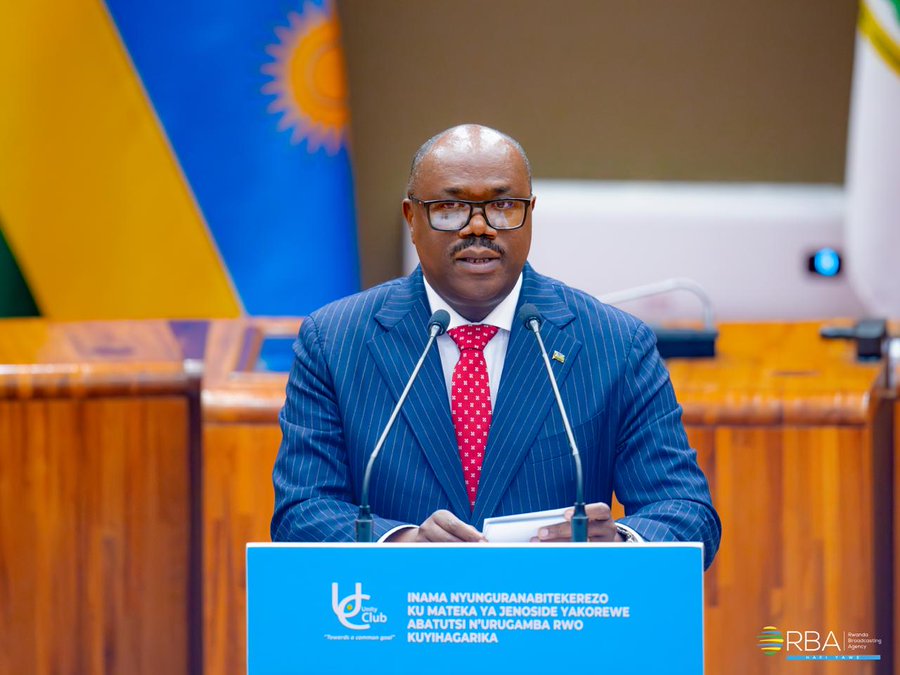
Prime Minister Dr Justin Nsengiyumva has called on every Rwandan to recognise that the country’s history concerns them directly, stressing that understanding and safeguarding it is a collective duty essential to preventing the recurrence of past atrocities.
He made the remarks on 22 May 2026 during a consultative forum on the history of the Genocide against the Tutsi and the liberation struggle, organised by Unity Club Intwararumuri.
The meeting took place at the Parliament building and brought together more than 500 participants, including government officials, leaders of religious institutions, civil society representatives, and youth delegates. It was held as Rwanda continues commemoration activities marking the 32nd anniversary of the Genocide against the Tutsi.
In his address, Prime Minister Nsengiyumva emphasised that every Rwandan must actively engage with the country’s history, noting that the genocidal ideology and divisive politics that led to the 1994 Genocide against the Tutsi left deep and lasting consequences that must be fully understood to ensure they are never repeated.
He said no citizen should feel detached from the nation’s past, insisting that learning, teaching, and reflecting on history should not be the responsibility of a few, but a shared national obligation. He warned that treating history as the concern of only a section of society would be a serious mistake.
The Prime Minister further highlighted that ethnic ideology, hatred, discrimination, and divisionism were central factors that enabled the Genocide against the Tutsi, which was both planned and executed by political leadership that mobilised ordinary citizens to participate in the killings.
He urged all Rwandans, including survivors and those born after 1994, to fully understand this history and draw lessons that promote vigilance, responsibility, and a commitment to preventing any form of hatred or violence in society.
Participants at the forum also reflected on persistent extremist ideology in the region, particularly in the Democratic Republic of Congo, noting similarities with the ideology that led to the 1994 Genocide against the Tutsi.
They expressed concern that individuals accused of involvement in past atrocities continue to find refuge in some foreign countries, including the DRC, describing this as a continuing challenge for Rwanda and regional stability.
Ambassador Jean Pierre Karabaranga noted that extremist ideology in eastern DRC mirrors what existed in Rwanda prior to 1994, adding that international inaction in the face of violence against Tutsi populations is reminiscent of the global response during the genocide period.
He argued that while the Genocide against the Tutsi was carefully planned and executed, the world is once again appearing to watch passively as similar patterns of ideology spread in the region, allegedly involving Congolese authorities and the FDLR armed group, composed of individuals implicated in the 1994 Genocide.
He further stated that the persistence of such ideology is enabled by external support, which emboldens perpetrators who believe they can act without consequence.
Karabaranga cited ongoing killings of Tutsi and Kinyarwanda-speaking communities in the DRC, arguing that the limited international response reflects historical failures witnessed during massacres in Rwanda.
He also pointed to the presence of MONUSCO forces operating in proximity to FDLR elements without decisive action, while Rwanda continues to be blamed for instability in eastern Congo, a situation he described as contradictory and unjust.