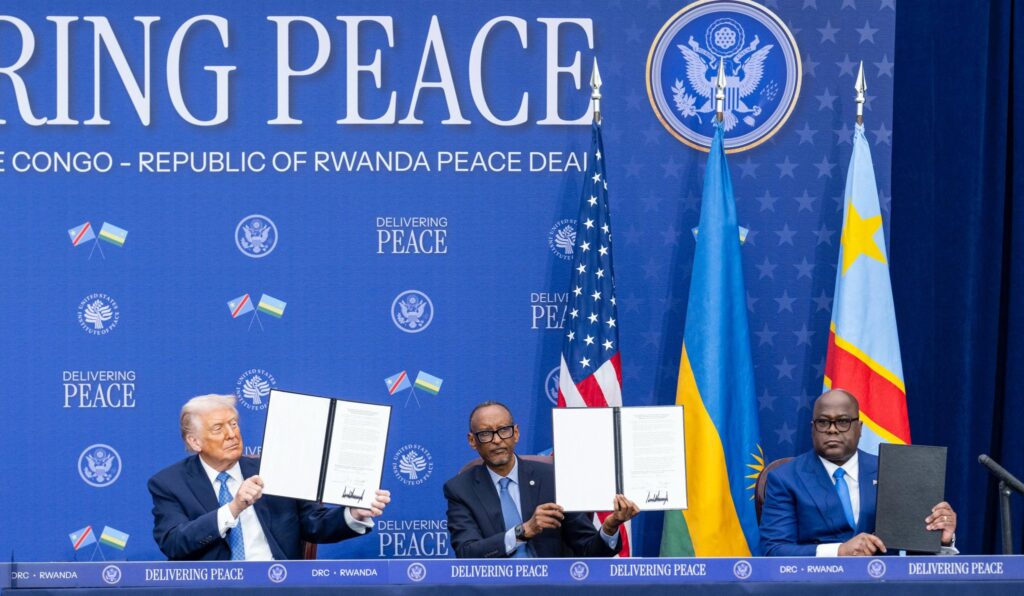
Rwanda and the Democratic Republic of the Congo (DRC) on Thursday signed a landmark peace agreement in Washington, D.C., marking one of the most significant diplomatic breakthroughs in Central Africa in three decades.
The accord, signed at the U.S. Institute of Peace, aims to end 30 years of conflict in eastern DRC, where more than 10 million people have been killed and millions displaced.
The ceremony was officiated by United States President Donald Trump, who described the Washington Accords as “a historic agreement that will end one of the longest running conflicts anywhere in the world.”
Speaking first, President Trump praised the presidents of Rwanda and the DRC—Paul Kagame and Félix Tshisekedi—as “courageous leaders” who had shown readiness to embrace peace. He said the agreement formalizes a permanent ceasefire, the disarmament of non-state armed groups, the voluntary return of refugees, and measures for justice and accountability.
“This conflict has lasted for 30 years,” Trump said. “Today, we commit to stopping decades of violence and bloodshed and to begin a new era of harmony and cooperation between the Democratic Republic of the Congo and Rwanda.”
The U.S. President also announced new bilateral arrangements between Washington, Kigali, and Kinshasa, including agreements on critical minerals and broader economic cooperation. He emphasized that the United States would deploy major companies to both countries to support responsible extraction of minerals and stimulate regional growth.
Trump thanked a broad delegation of African leaders and partners in attendance—including the presidents of Angola, Burundi, Kenya, and the Council of Ministers of Togo; Uganda’s vice president; ministers from Qatar and the United Arab Emirates; and the chairperson of the African Union Commission. He also commended Secretary of State Marco Rubio and Senior Advisor Massad Boulos for their role in brokering the agreement.
“We have the clearest and most viable path forward that we have ever had,” Trump said. “These two very good men are heroes today.”
Kagame: “Rwanda will not be found wanting”
Taking the podium as the second speaker, President Paul Kagame of Rwanda expressed deep appreciation to President Trump, Qatar, and regional leaders who supported the mediation process. He noted that previous peace efforts over three decades had failed due to the absence of a “pragmatic, even-handed approach” that focused on future opportunities rather than past grievances.
“No one was asking President Trump to take up this task,” Kagame said. “But when he saw the opportunity to contribute to peace, he immediately took it.”
Kagame credited the U.S. mediation team for bringing a new dynamism that allowed Rwandan and Congolese negotiators to reach consensus on long-standing points of contention. He said the Washington Accords offer the “most viable path” to ending the conflict once and for all, adding that success now rests on the commitment of both countries.
“If this agreement falters, the responsibility will not lie with President Trump but with ourselves,” Kagame said. “Rwanda will not be found wanting. Our only objective is for our country to be safe and secure after having endured so much tragedy.”
He reaffirmed Rwanda’s readiness to implement all commitments and to work toward a stable and prosperous regional future.
Tshisekedi: “A turning point for our nations”
DRC President Félix Tshisekedi, speaking last, described the agreement as a moment of “deep gratitude and clear hope” for the people of Congo. He saluted President Trump, regional mediators, and African leaders who supported the process, including Angola’s João Lourenço, Kenya’s former President Uhuru Kenyatta, and Qatar’s Sheikh Tamim bin Hamad Al Thani.
“The Washington Agreements are not yet another document,” Tshisekedi said. “They represent a turning point… to finally overcome the cycle of violence, forced displacements, mistrust and defiance.”
Tshisekedi pledged the DRC’s full commitment to implementing the peace terms “with seriousness and rigor,” emphasizing respect for territorial integrity, the fight against armed groups, and an end to support for negative forces destabilizing the region.
He urged Rwanda to show equal commitment, noting that the new framework is built on mutual respect, non-interference, and economic cooperation.
“This day is the beginning of a new path,” Tshisekedi said. “Peace will not just be a wish, but a turning point. The Democratic Republic of the Congo will fully play its part—vigilant, yet resolutely optimistic.”
A new chapter for the Great Lakes region
The Washington Accords combine a declaration of principles, a formal peace agreement, and a regional economic integration framework aimed at transforming relations between the two neighboring countries. The deal seeks to dismantle armed group networks, build shared prosperity, and create conditions for long-term stability in the Great Lakes region.
As leaders shook hands and exchanged brief private words at the end of the ceremony, the moment was described by U.S. officials as a rare and historic step forward in a region long scarred by conflict.
Whether the commitments hold will depend on mutual trust, implementation on the ground, and sustained support from regional and international partners. But for now, Washington has set the stage for what could become a defining chapter in Central Africa’s pursuit of peace.