Rwanda has reaffirmed its commitment to pursue economic development alongside environmental protection, with officials saying both priorities must advance together as the country responds to the impacts of climate change.
Minister of Environment Dr. Bernadette Arakwiye said Rwanda has deliberately chosen a development model that integrates environmental sustainability into economic planning, rather than treating the two as competing objectives.
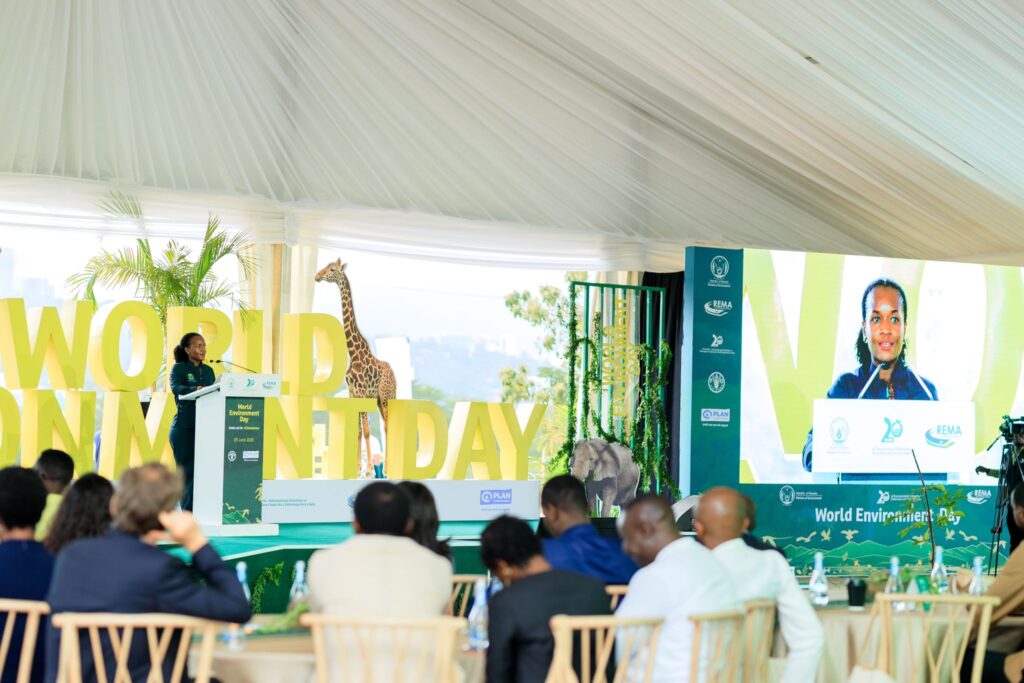
She made the remarks during celebrations marking World Environment Day, held alongside the 20th anniversary of the Rwanda Environment Management Authority (REMA).
Dr. Arakwiye said Rwanda has made significant progress in ecosystem restoration, sustainable land management, climate-resilient infrastructure and the promotion of green jobs.
She highlighted the Green Gicumbi project as a key example of climate adaptation efforts, noting that it has contributed to restoring degraded land and improving livelihoods over the past six years.
The minister also stressed the importance of data and technology in guiding climate action, saying evidence-based decision-making is essential for effective investment and planning.
“There is no better tool than accurate data in the fight against climate change. Investment is important, but it is most effective when guided by reliable information that helps us make better decisions,” she said.
Dr. Arakwiye said Rwanda is advancing programmes focused on sustainable land use, ecosystem management and the development of climate-resilient urban areas.
She added that economic growth must go hand in hand with clean air, sustainable transport systems, improved waste management and environmentally friendly industrial development.
“As a country, we have chosen to pursue development and environmental protection together. Our responsibility and opportunity is to advance both at the same time,” she said.
Rwanda has set a target of reducing greenhouse gas emissions by 53% by 2035 under its Nationally Determined Contributions (NDCs), despite contributing a small share of global emissions while facing increasing climate-related disasters such as floods, landslides and droughts.
Dr. Arakwiye said achieving this goal will require an estimated $12 billion in investment, including $5 billion for mitigation and $7 billion for adaptation measures.
UNDP Resident Representative Dr. Fatmata Lovetta Sesay said REMA’s evolution over the past two decades demonstrates how environmental protection can be integrated into national development strategies.
She noted that the agency has shifted from a primarily enforcement-focused institution to one that supports stakeholders in aligning development goals with environmental sustainability.
She added that REMA’s transformation positions it as a leading example of environmental governance in Africa.