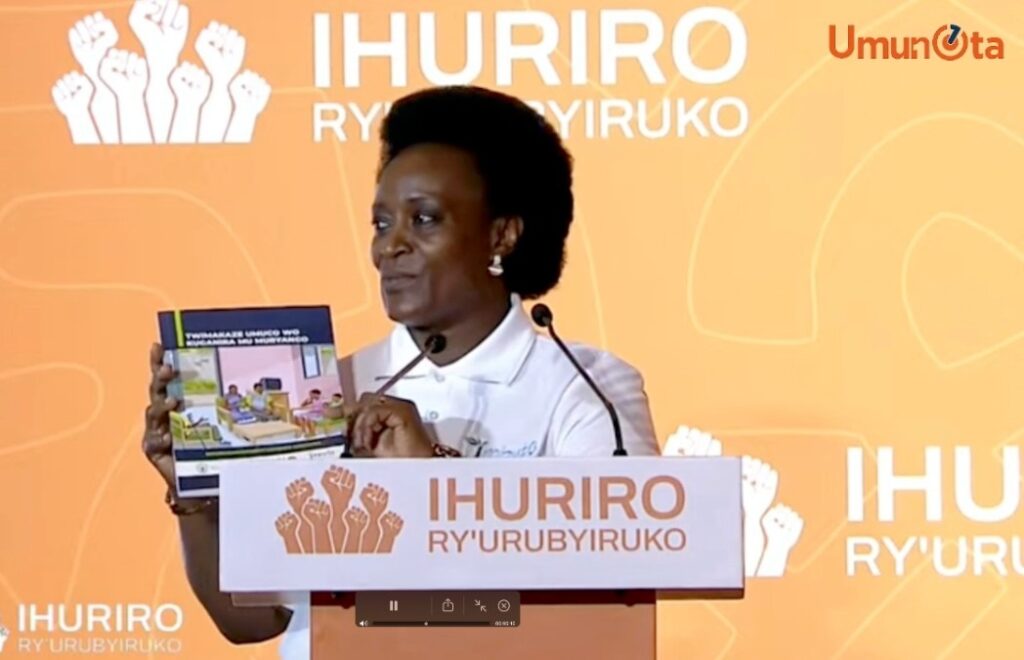
The Minister of Gender and Family Promotion, Uwimana Consolée, has officially launched a new training guide designed to strengthen family communication on sexual and reproductive health, with a focus on preventing teenage pregnancies and improving adolescent wellbeing.
The guide was unveiled on Friday, June 26, 2026, during a youth forum organized by Imbuto Foundation, which brought together more than 2,000 participants, mainly young people, at the Kigali Convention Centre.
The forum focused on accelerating efforts to prevent and eliminate teenage pregnancies in Rwanda, a challenge that continues to raise concern among policymakers and health experts.
Minister Uwimana emphasized the importance of open, consistent dialogue within families, saying it plays a central role in protecting children from abuse and guiding them toward informed life decisions.
“We want this guide to serve as a tool that helps parents engage their children in continuous conversations, building trust from early childhood through adolescence,” she said.
The newly launched guide is intended to equip parents and caregivers with practical tools to address sensitive issues such as sexual and reproductive health in a structured and age-appropriate manner.
Officials said the initiative is part of broader efforts to strengthen family-based interventions, recognizing that communication within households is critical in shaping adolescent behavior and preventing risky choices.
In addition to the guide, Imbuto Foundation has developed two supporting publications, Agaciro Kanjye and Tuganire Mwana Wanjye, aimed at facilitating dialogue between parents and children on key life and health issues.
The materials are expected to help bridge communication gaps within families and improve confidence in addressing topics that are often considered sensitive, particularly those related to adolescent development and reproductive health.
The initiative comes amid ongoing concern over teenage pregnancy in Rwanda, where recent data shows that around 60 adolescent girls become pregnant every day, equivalent to more than 23,000 cases annually.