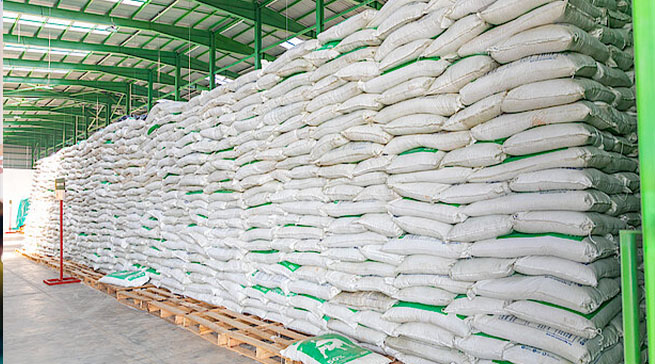
Rwanda will source about 40% of the fertilizer required for the 2027A agricultural season from domestic production, as the country accelerates efforts to reduce dependence on imports and stabilize farm input prices.
The announcement was made by the Minister of Agriculture and Animal Resources, Dr. Telesphore Ndabamenye, during a press briefing on revised agricultural input prices and guidelines for the upcoming planting season.
Officials said a total of 60,000 tonnes of fertilizer will be used during the 2027A season, of which 25,000 tonnes will be locally manufactured. The government plans to increase the share of locally produced fertilizer to more than 50% in the following season.
Dr. Ndabamenye said boosting domestic production is aimed at cushioning farmers against global price shocks, noting that Rwanda remains heavily dependent on imported fertilizer whose cost is influenced by international markets.
Fertilizer prices sharply revised
The Ministry of Agriculture and Animal Resources (Ministry of Agriculture and Animal Resources (MINAGRI)) also announced significant increases in fertilizer prices for the 2027A season, citing global economic pressures.
Urea recorded the sharpest rise, increasing by 66% from Rwf 1,190 to Rwf 1,980 per kilogram. NPK 17-17-17 (Compound) rose by 36% to Rwf 1,861 per kilogram, while the blended version increased by 34% to Rwf 1,780 per kilogram. DAP rose by 15% to Rwf 1,950 per kilogram.
The ministry attributed the increases to geopolitical tensions, rising energy costs used in fertilizer production, higher global fuel prices, and fluctuations in the US dollar exchange rate.
Officials noted that the price changes reflect international market conditions and could be adjusted depending on future global developments.
Subsidies maintained for farmers
Despite the price hikes, the government confirmed that subsidies will continue to protect farmers from the full impact of global cost increases.
Key staple crops including maize, beans, wheat, rice, soybeans, potatoes, cassava, bananas, vegetables, and fruits will continue to benefit from government support.
Subsidy rates vary depending on fertilizer type, with support levels reaching 46% for DAP, 45% for urea, 43% for NPK 17-17-17, and 45% for coated urea.
Officials said the policy is part of broader efforts to boost agricultural productivity, strengthen food security, and reduce reliance on imported inputs.