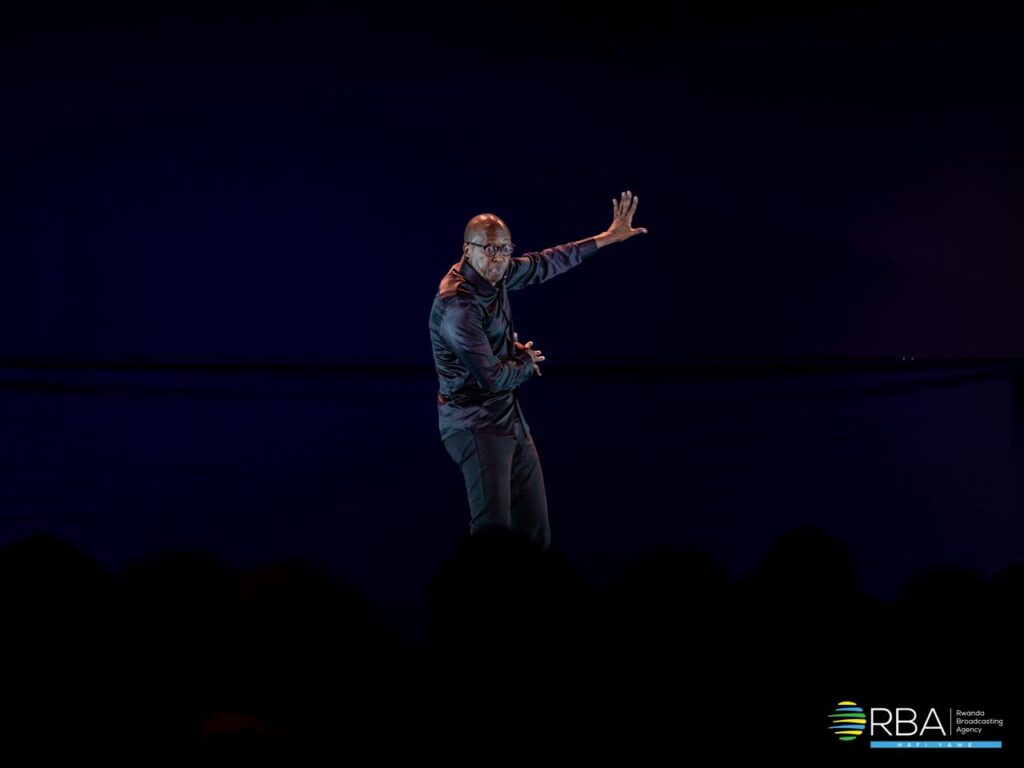
Actor, comedian and author Ntarindwa Diogène, popularly known as Atome, has presented his one-man show, Carte d’identité, which explores Rwanda’s history, particularly the country’s journey through difficult times and the role of young people in the liberation struggle.
The performance took place on Saturday evening, November 7, 2026, at the Kigali Convention Centre.
First Lady Jeannette Kagame was among those who attended the show, which has been staged in different countries around the world for nearly 20 years.
Atome said he developed Carte d’identité based on his personal family history and the contribution of young people to Rwanda’s liberation struggle.
Before presenting the show, Ntarindwa gave the audience a preview of another project he is developing, focusing specifically on the liberation struggle. Titled Legacy Project: Igitaramo cy’Inkotanyi, the production is expected to be presented to Rwandans in 2027.
The audience also got a taste of the soundtrack accompanying Carte d’identité, featuring songs and rhythms that were prominent during Rwanda’s liberation struggle.
Carte d’identité is a historical performance that traces different periods in Rwanda’s history while highlighting the contribution of Rwandans, particularly young people, to the country’s liberation.
Atome is among the artists who use comedy, theatre and other creative forms to communicate important messages.
Highlights from the performance
Performed in French, Carte d’identité explores the life of Atome’s father, Philippe Niwemuto, and his journey into exile after fleeing Rwanda through the southern part of the country, passing through Zaire before eventually reaching Burundi.
Portraying his father, Atome recounted what drove him to flee after witnessing cattle being slaughtered and cut into pieces in the Ngororero area, with their blood mixing with milk. The experience prompted him to leave his parents behind after they refused to flee. It was the last time he saw them.
He went on to recount how his family settled in Burundi, where he was born and raised, describing their life in exile while explaining that their longing to return to Rwanda never faded.
Although rooted in a painful history, Atome transformed the story into a work of comedy, blending laughter with reflection on Rwanda’s past, the experience of exile and what it means to be Rwandan.