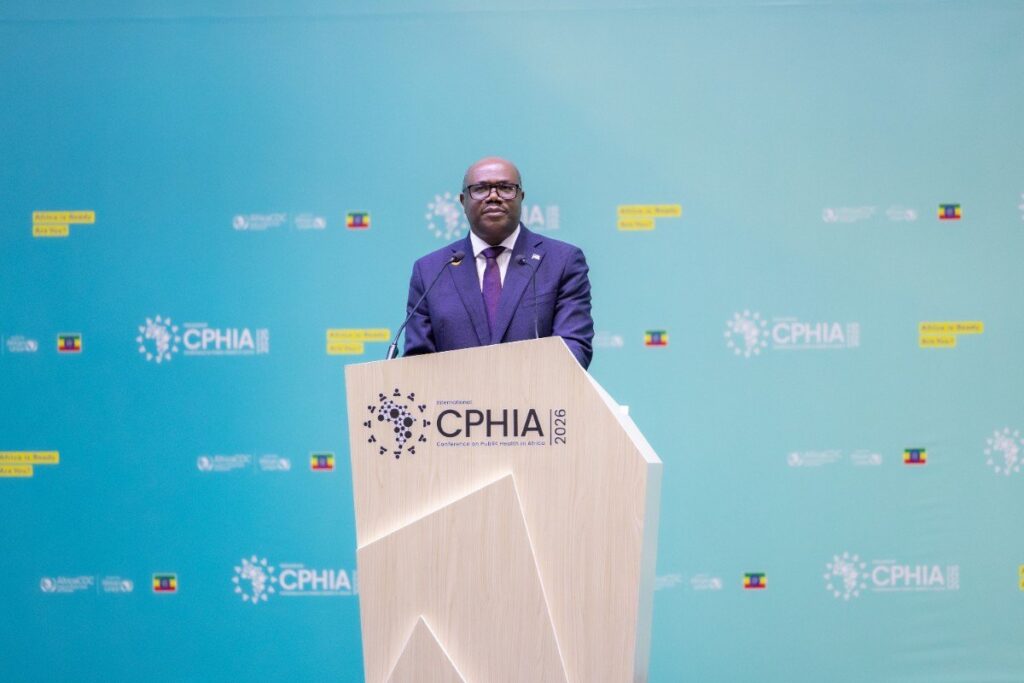
Rwanda’s Prime Minister, Dr Justin Nsengiyumva, has called on African countries to strengthen domestic financing for healthcare rather than continue relying on declining foreign aid.
He made the remarks at the fifth International Conference on Public Health in Africa (CPHIA 2026), taking place in Addis Ababa, Ethiopia, where he is representing President Paul Kagame. The conference is discussing strategies to improve healthcare delivery and strengthen countries’ health systems.
Nsengiyumva noted that international funding for healthcare is declining even as diseases and other health challenges continue to increase, making it necessary for African countries to develop sustainable solutions using their own resources.
“We cannot continue depending on others to solve our basic healthcare challenges. Africa must develop its own capacity to finance its health systems,” he said.
He clarified that this does not mean ending international partnerships, but rather establishing a new approach in which African countries set their own priorities and needs, while development partners support their implementation.
Citing Rwanda’s experience, he highlighted the Community-Based Health Insurance scheme, commonly known as Mutuelle de Santé, which has helped expand access to healthcare over the past 25 years. More than 89 per cent of Rwandans are enrolled in the scheme.
He said that since 2000, infant mortality has declined from 107 to 27 deaths per 1,000 live births, while maternal mortality has fallen from 1,071 to 149 deaths per 100,000 live births. Life expectancy has also increased from 50 to 70.5 years.
The Prime Minister further pointed to Rwanda’s experience in containing the Marburg outbreak in 2024 as evidence of the importance of building strong health systems before emergencies arise.
He said community health workers screened more than 9.5 million people in a country with a population of nearly 14 million, enabling the outbreak to be contained within three months.
“The capacity to test for diseases, track their spread, maintain a skilled workforce and respond to emergencies must be permanent features of our health systems, rather than measures introduced only when a crisis occurs,” he said.
Nsengiyumva also urged African countries to invest in pharmaceutical and vaccine manufacturing, promote technological innovation and integrate their markets to reduce dependence on products imported from outside the continent.
He called for greater cooperation among African countries to build resilient health systems capable of responding to public health challenges, stressing that the future of healthcare on the continent will depend on what countries achieve through collective efforts.