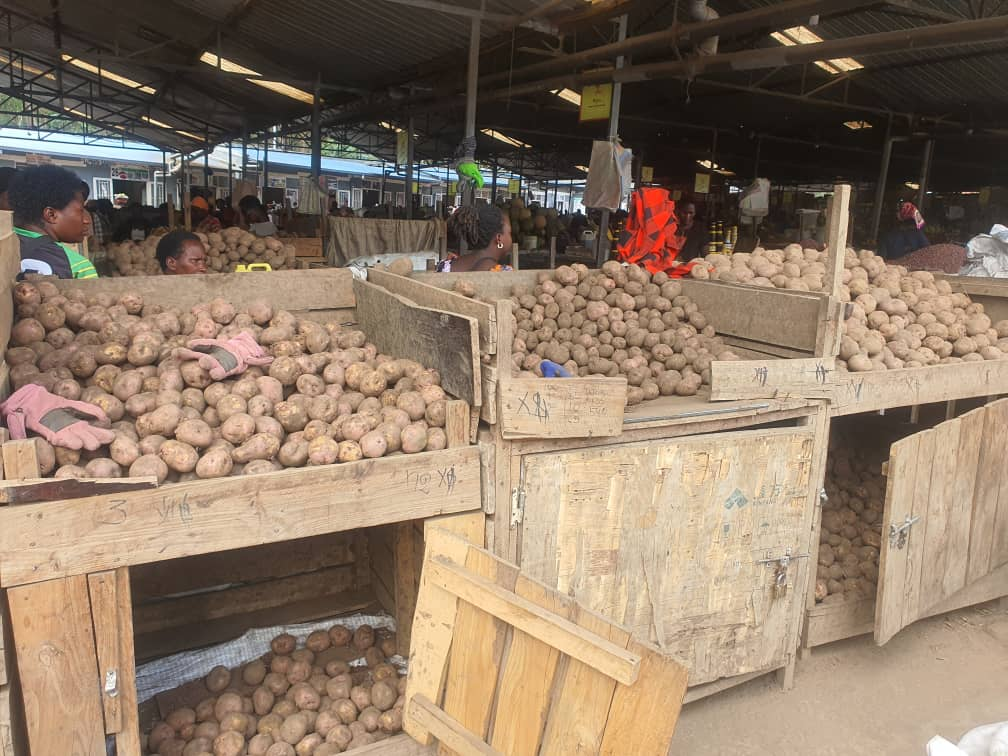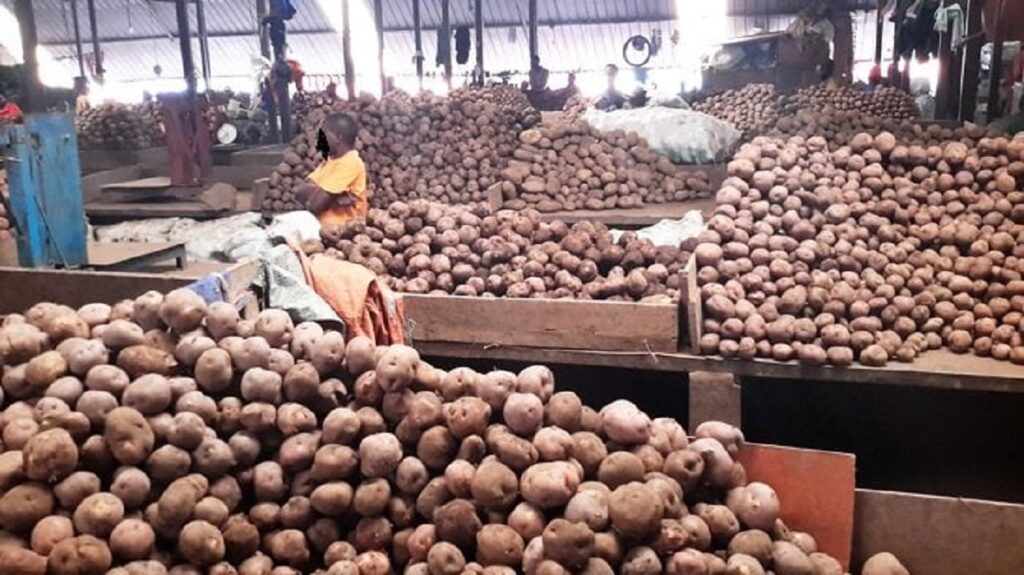
Potato prices continue to surge across Rwanda despite steady growth in national production, raising concerns among consumers and prompting questions about why increased output has failed to ease market costs.
Potatoes are among Rwanda’s most consumed staple foods, and their rising prices have become a recurring concern in markets across the country, affecting both traders and households.
Data released by the National Institute of Statistics of Rwanda (NISR) show that potato production increased across all farming seasons in 2025. Production reached 475,700 tonnes in Season A, 314,000 tonnes in Season B, and 94,800 tonnes in Season C.
Overall, Rwanda’s potato output rose by 17% in 2025, increasing from 827,355 tonnes in 2024 to 884,500 tonnes.
Agricultural survey findings for Season 2026 A also indicated continued growth, with production rising by 3.3% to reach 491,564 tonnes.
Despite the increasing harvests, market prices have continued climbing rather than declining.
Farmers attribute the trend largely to soaring production costs, saying expenses linked to fertilizers, pesticides and other agricultural inputs have sharply increased over recent years.
They argue that the rising cost of farm inputs directly affects retail prices and are calling on the government to increase subsidies and support mechanisms to help stabilize potato prices for consumers.
One farmer said the price of agricultural chemicals has nearly tripled.
“Today, farming chemicals have become extremely expensive, increasing by almost 200%. A product we used to buy for between Rwf 75,000 and Rwf 80,000 now costs around Rwf 180,000, and we expect it could soon reach Rwf 200,000. We ask the government to help farmers access inputs at affordable prices,” the farmer said.
The Rwanda Agriculture and Animal Resources Development Board (RAB) acknowledges that while potato production continues to increase annually, supply still does not fully meet growing domestic and regional demand.
Speaking to Rwanda Broadcasting Agency (RBA), RAB Acting Director General Florence Uwamahoro said authorities are implementing several measures aimed at increasing production and easing price pressure.
The measures include expanding potato farming into new regions and developing seed varieties adapted to different climatic zones across the country.
“We are taking several measures aimed at increasing potato production, including identifying new areas where potatoes can thrive. New seed varieties have been developed for Eastern and Southern Rwanda to complement Northern and Western provinces, where potato farming has traditionally been concentrated,” she said.
According to NISR, the districts of Rubavu, Nyabihu, Musanze and Burera remain Rwanda’s leading potato-producing regions relative to cultivated land area.
Recently, Rwanda Agriculture and Animal Resources Development Board and Ministry of Agriculture and Animal Resources announced the development of improved potato seed varieties engineered to be more resistant to diseases and climate change while requiring less chemical treatment.
Dr. Patrick Karangwa, Director General in charge of Agricultural Modernization at MINAGRI, said recent research on the improved seeds showed significantly higher yields.
“Research we recently conducted found that fields planted with the new seed varieties produced between 34 and 36 tonnes per hectare, compared to only 2 to 3 tonnes per hectare from conventional seeds,” he said.
Farmers say their long-term goal is to raise average potato yields to 30 tonnes per hectare, up from the current national average of between 8 and 12 tonnes per hectare in many farming areas.