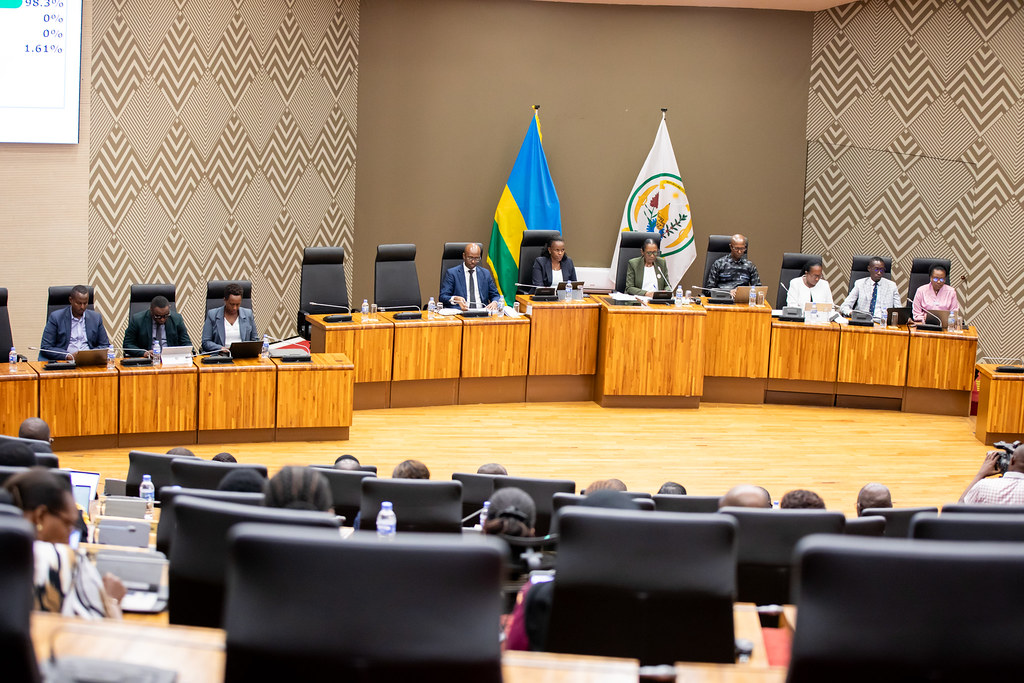
Rwanda’s Chamber of Deputies has approved a national budget of Rwf7,796 billion for the 2026/2027 fiscal year, marking a 12 percent increase compared to the revised 2025/2026 budget.
The budget, which will guide government spending starting in July 2026, was adopted on June 24, 2026, by 63 Members of Parliament during a plenary session.
The total budget is fully financed through a mix of domestic revenues, grants, and borrowing, with domestic resources and loans accounting for about 93 percent of total funding.
Tax revenues are projected to contribute 56.8 percent, other revenues 7.5 percent, external grants 7 percent, domestic borrowing 3.4 percent, and external loans 25.3 percent.
On the expenditure side, Rwf5,306.5 billion (68 percent) is allocated to recurrent spending, while Rwf2,489.7 billion (32 percent) is dedicated to development projects and public investment.
Minister of Finance and Economic Planning Yusuf Murangwa told Parliament that the budget is aligned with the three pillars of Rwanda’s National Strategy for Transformation (NST2): economic transformation, social transformation, and transformational governance.
The economic transformation pillar receives the largest share at Rwf4,900.8 billion (62.9 percent), focusing on agriculture modernization, industrial development, job creation, financial sector strengthening, and climate resilience.
The social transformation pillar is allocated Rwf1,834.2 billion (22 percent), targeting improvements in education, healthcare, nutrition, early childhood development, and social protection programmes.
The governance and justice pillar receives Rwf1,188.2 billion (15.1 percent), aimed at strengthening public service delivery, rule of law, citizen participation, and national security.
Officials said about Rwf400 billion was reallocated within the budget to prioritize urgent national priorities following consultations with government institutions.
Key adjustments include an additional Rwf3.08 billion for the agriculture sector, raising its allocation to Rwf355.6 billion, and Rwf7.2 billion added to social protection programmes, increasing the total to Rwf59.7 billion.
The transport sector saw a slight reduction due to the completion of some ongoing projects, while funding for feeder roads was increased by Rwf483 billion to improve rural connectivity.
The government said the budget prioritizes inclusive growth, job creation, improved service delivery, and long-term economic resilience as Rwanda advances its development agenda under NST2.