Elias Hakizimana

Niyigena Radjabu

Niyigena Radjabu is a professional Rwandan journalist with three years of experience in the media industry, specializing in investigative reporting on public affairs and Rwanda-related topics. He currently works as a journalist for Umunota.com, one of Rwanda’s leading digital news platforms.

A United Nations report has revealed that the Democratic Forces for the Liberation of Rwanda (FDLR) has fragmented into three main factions, a restructuring that experts say has enabled the armed group to maintain its operations while disguising its command structure in eastern Democratic Republic of Congo (DRC).
Rwanda's Minister of Foreign Affairs and International Cooperation, Ambassador Olivier Nduhungirehe, joined his Israeli counterpart, Gideon Saar, Rwandans living in Israel, and friends of Rwanda in Jerusalem to commemorate the 32nd anniversary of Rwanda's Liberation Day.
President Paul Kagame has been appointed co-chair of the newly established AI for Good Global Commission, a United Nations-backed body created to promote the responsible use of artificial intelligence (AI) for global development.
Rwandans living in the Netherlands have celebrated Rwanda’s 32nd Liberation anniversary, paying tribute to the Rwanda Patriotic Army (RPA) for stopping the Genocide against the Tutsi and leading the country’s recovery journey.
During an official visit to Israel, Rwanda’s Minister of Foreign Affairs and International Cooperation, Olivier Jean Patrick Nduhungirehe, visited the Old City of Jerusalem and the Western Wall, one of the most significant religious and historical sites in the world.
Eight percent of women aged 15 to 49 in Rwanda who had ever been pregnant reported experiencing physical violence during pregnancy, according to the 2025 Rwanda Demographic and Health Survey (RDHS), highlighting the continued vulnerability of women during one of the most critical stages of their lives.
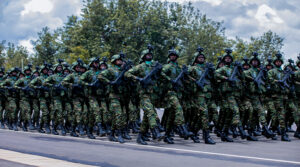
Rwanda Defence Force (RDF) spokesperson Brig Gen Patrick Karuretwa has said the decision by the Rwanda Patriotic Army (RPA) not to take revenge after defeating the former regime forces in 1994 was a remarkable and deliberate choice rooted in disciplined leadership.
Rwanda has reduced deaths among children under the age of five by more than 80% over the past 25 years, according to the 2025 Rwanda Demographic and Health Survey (RDHS), reflecting major gains in maternal and child healthcare.
The integration of former Rwanda Patriotic Army (RPA) and former Rwandan Armed Forces (FAR) soldiers after the 1994 Genocide against the Tutsi demonstrated that Rwanda’s greatest enemy was not the soldier on the battlefield but bad governance, Rwanda Defence Force (RDF) spokesperson Brig. Gen. Patrick Karuretwa has said.
It has been 32 years since the Rwanda Patriotic Army (RPA) Inkotanyi ended the liberation war that began in October 1990 and concluded in July 1994, a conflict marked by both armed struggle and negotiations aimed at ending the crisis.