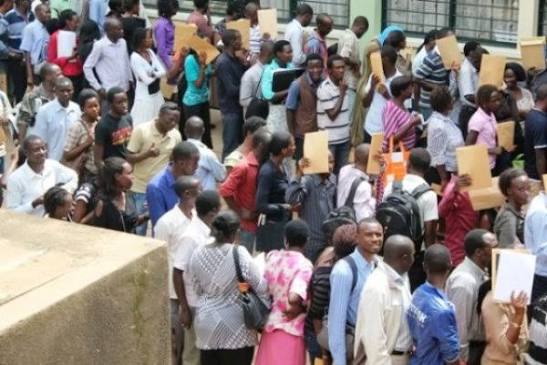
A total of 469,532 people applied for government jobs in Rwanda during the 2025/2026 financial year, but only 2,512 were recruited, representing just 0.54 per cent of all applicants, according to the Public Service Commission.
The figures are contained in the commission’s activity report presented to both chambers of Parliament on October 21, 2026.
The report shows that 988 recruitment competitions were announced during the financial year to fill 3,370 positions. However, 176 vacancies remained unfilled.
Of the applicants, 295,731 were men, accounting for 63 per cent, while 173,801 were women, representing 37 per cent.
Applications from 228,451 candidates, equivalent to 48.7 per cent of the total, were accepted, while 241,081 were rejected because the applicants did not meet the requirements.
Among those eligible to compete for the positions, only 49,651 sat the recruitment examinations. They included 31,502 men and 18,149 women.
A total of 6,831 candidates passed the examinations, representing 13.8 per cent of those who sat them. Of these, 2,512 were recruited, including 1,509 men and 1,003 women.
Another 3,781 candidates were placed on a waiting list, while 323 declined the positions offered to them. A further 126 candidates were not appointed because they failed to meet the requirements, despite having passed the examinations.
The report is based on information compiled from 252 recruitment competition reports submitted by 90 public institutions.
Of these reports, 45 contained irregularities. These included 40 cases involving candidates who did not meet the requirements, two cases in which candidates failed to provide proof that their foreign qualifications were equivalent to those awarded in Rwanda, two incomplete reports and one case of examination malpractice.
More than 4.5 million Rwandans underutilised in the labour market
While the figures highlight the limited number of applicants securing government jobs, data from the National Institute of Statistics of Rwanda (NISR) show that 4,594,976 Rwandans, equivalent to 61.8 per cent, are experiencing some form of labour underutilisation.
This includes 877,716 unemployed people, 1,910,195 people working fewer hours than they would like, and 1,807,065 people who are available to work but are not seeking employment.
The figures indicate that difficulties in finding work or securing sufficient employment continue to affect a large section of the population across different demographic groups.
Women are more affected by labour underutilisation than men, with a rate of 68.6 per cent compared with 54.7 per cent among men.
The data also reveal a significant gap between urban and rural areas. Labour underutilisation stands at 47.7 per cent in urban areas, compared with 68.4 per cent in rural areas.
The figures point to a more pronounced employment challenge in rural communities, where many people struggle to find sufficient work or fully use their skills and productive capacity.