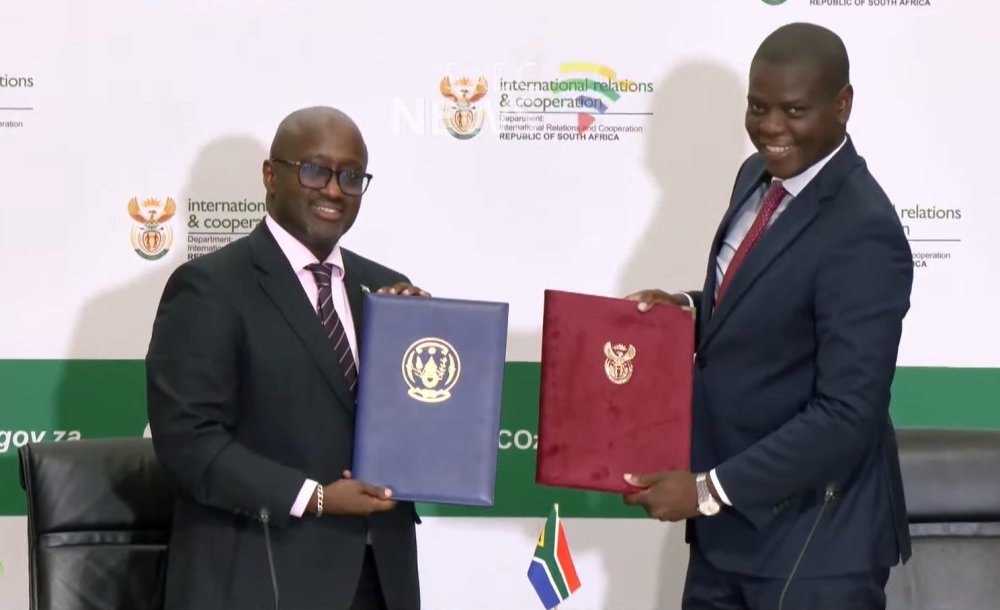
Talks between Rwanda and South Africa have signaled renewed momentum toward rebuilding bilateral relations after years of diplomatic strain, with both sides expressing willingness to deepen cooperation and address longstanding disagreements.
The discussions brought together Rwanda’s Minister of Foreign Affairs and International Cooperation, Amb. Olivier Nduhungirehe, and South Africa’s Minister of International Relations and Cooperation, Ronald Lamola, in Pretoria.
Both officials underscored the importance of restoring trust and strengthening cooperation between the two countries, which share deep historical links but have experienced periods of political tension.
Minister Lamola said that despite past disagreements, relations between South Africa and Rwanda remain anchored in friendship, mutual understanding, and respect.
“Despite disagreements on some matters, relations between our countries have continued to be characterized by friendship, mutual understanding, and cooperation founded on mutual respect. South Africa and Rwanda have a responsibility to work more closely together because there is much that unites the people of our two countries,” he said.
He emphasized that both nations share similar historical experiences that continue to shape their national identities, referencing South Africa’s apartheid past and the 1994 Genocide against the Tutsi in Rwanda.
“Our countries have endured painful chapters in history. South Africa experienced the injustices of apartheid, while Rwanda suffered the Genocide against the Tutsi. We cannot forget these histories, and we will continue to honor those who sacrificed their lives to build the foundations of the South Africa and Rwanda we know today,” he added.
Lamola noted that efforts to normalize relations were already underway through diplomatic engagements at both ministerial and presidential levels, aimed at rebuilding trust and expanding cooperation.
He further said the two governments share a common vision for a peaceful and prosperous African continent driven by sustainable development and stronger regional integration.
“Our leaders share a strong vision of rebuilding and revitalizing relations between our countries. They are united by their commitment to Africa and their confidence in the continent’s vast potential for its people. Their aspiration is to see an Africa that is peaceful, secure, and sustainably developed,” he said.
One of the key issues discussed during the talks was the visa restrictions affecting Rwandan citizens traveling to South Africa. Lamola indicated that progress was being made toward easing these restrictions.
“This meeting will also help advance efforts to lift visa restrictions for holders of ordinary Rwandan passports traveling to South Africa,” he said, suggesting that a resolution could be reached soon.
He also welcomed Rwanda’s decision to lift restrictions on imports of animal products from South Africa. Rwanda had imposed the restrictions in 2017 following an outbreak of listeriosis.
On his part, Minister Nduhungirehe highlighted the depth of historical ties between the two countries, arguing that past disagreements should not overshadow the broader relationship.
He acknowledged South Africa’s role in supporting Rwanda’s recovery and reconstruction efforts after the 1994 Genocide against the Tutsi, as well as its contribution to economic development through investment and private sector engagement.
He cited the entry of MTN Group into Rwanda as a significant example of South African investment that has contributed to the country’s growth.
“South Africa has played an important role in supporting Rwanda’s economic development by encouraging investment and promoting private-sector participation. A clear example is MTN Group, which has become one of the leading providers of telecommunications and digital services in the country,” he said.
Nduhungirema noted that MTN Rwanda has created employment opportunities, supported technological advancement, and expanded access to modern communication services for Rwandans.
“These contributions reflect the strong relationship between Rwanda and South Africa and demonstrate South Africa’s support for Rwanda’s journey of reconstruction, peacebuilding, and socio-economic development following the Genocide against the Tutsi,” he added.
He further stressed that despite past tensions, the relationship between Rwanda and South Africa remains resilient and grounded in shared history and mutual interests.
“Whatever challenges may have arisen between our countries, we believe the relationship between Rwanda and South Africa remains resilient. It is built on shared history, mutual trust, and the common interests of our peoples,” he said.
Relations between the two countries have experienced periods of tension in recent years, largely linked to security concerns raised by Rwanda, which accused South Africa of hosting individuals allegedly involved in activities aimed at destabilizing Rwanda.
However, the latest engagements signal a renewed diplomatic effort by both sides to move beyond past disputes and rebuild cooperation in areas including trade, investment, health, and mobility.